Sedai Alternatives and Sedai Competitors for Autonomous Cloud Optimization
Sedai sells an autonomous optimization platform that tunes running workloads on its own: Kubernetes on EKS, AKS and GKE, Amazon ECS and Fargate, AWS Lambda, virtual machines, storage, databases, Databricks and, more recently, GPUs and AI agents. You start in Copilot, approving each change with one click, and move to Autopilot when you trust it. It is priced per managed vCPU through a Sedai Billing Unit on a fixed annual commitment, and the rate per unit is not published. People look for a Sedai alternative for three reasons: they need a number before a sales call, their problem is mostly Kubernetes and a specialist may be cheaper, or they want the savings found but not applied by software in production. This guide prices the alternatives at the same 1,000 vCPUs wherever a public rate exists.
projected this month if unattended
Spend by team
Budget forecast
The short answer
The best Sedai alternative depends on what you want automated. For Kubernetes only, PerfectScale by DoiT ($2 per vCPU a month on Advanced), StormForge Optimize Live ($2.70 per vCPU a month on contract) and CAST AI ($1,000 a month plus $5 per CPU) publish rates, and ScaleOps prices a platform fee plus a per vCPU meter. For VMs and containers together, IBM Turbonomic is the closest like-for-like, at $37,909.82 a year per 200 managed virtual servers on AWS Marketplace. If you want waste found but changed by your own engineers, AWS Compute Optimizer is free and CostAnalyst starts at $59 a month, read-only.
Building a budget for a Sedai quote first? Our Sedai pricing breakdown explains the Sedai Billing Unit and the $1 Marketplace proof of concept, and the agentic FinOps platforms guide covers the wider category.
CostAnalyst is on this list, so the plain version first. We do not change anything in your cloud. We read AWS, Azure and Google Cloud billing exports and SaaS spend read-only, show idle and oversized resources and the team that owns them, and leave the change to your engineers. If you want software to resize pods and functions in production, Sedai and the specialists below do that and we do not.
How we compared
Five things that actually separate these tools
What the price is counted on
Sedai charges 1 Sedai Billing Unit for each vCPU its platform manages, on a fixed annual commitment, and its pricing FAQ says there are no overage penalties: extra usage is billed at the same rate. PerfectScale, StormForge and ScaleOps also count vCPUs; CAST AI counts CPUs with a monthly platform fee; Turbonomic counts managed virtual servers; PointFive counts total annual cloud spend. Convert every quote to an annual cost for your real vCPU count before you compare, because the units hide the differences.
Which workloads it can touch
Sedai is unusual in covering Kubernetes, ECS, Fargate, Lambda, VMs, storage and data workloads from one product. Most alternatives are Kubernetes specialists. If 80 percent of your compute is in EKS or AKS clusters, a specialist covers the money and is usually cheaper. If a large share runs on Lambda, ECS or plain EC2, check line by line which tool can act on it, because a Kubernetes tool will leave it untouched.
How autonomy is granted and taken back
Sedai has explicit modes: Datapilot for observation, Copilot for one-click approval and Autopilot for autonomous execution. Ask every alternative the same three questions. Can autonomy be set per workload rather than per account? What happens to a change in flight if you switch back to approval mode? Can an engineer reverse an automated change without a support ticket? A tool you cannot step back from usually ends up running read-only under an IAM policy.
What leaves your environment
Autonomous tools need write access and a data path. Sedai is SaaS with SOC 2 Type 2; StormForge says only anonymized usage metrics leave the cluster; ScaleOps also offers self-hosted and air-gapped installs; PerfectScale Expert supports self-hosting. If security has to sign off, ask for the exact IAM policy and the list of fields sent outside your account before the proof of concept, not after.
Contract shape and exit terms
Sedai's AWS Marketplace listing says "We do not currently offer refunds", and so do CAST AI and PerfectScale; StormForge calls its fees non-refundable and IBM calls Turbonomic orders non-cancellable. Annual commitments are the norm in this market. The protection you can actually get is a short paid pilot, a commitment sized below your current vCPU count, and the right to adjust the commitment at renewal, which Sedai's FAQ says it allows.
At a glance
10 Sedai alternatives compared
← Scroll to see all columns →
| Tool | Best for | How you are billed | What it changes in production | Published price |
|---|---|---|---|---|
| Sedai (the baseline) | Organizations where Kubernetes, serverless and VMs all leak money and the team wants one autonomous platform for all of them | 1 Sedai Billing Unit per managed vCPU, fixed annual commitment | Copilot one-click approval or Autopilot autonomous changes | Quote only; $1 for a 30-day proof of concept on AWS Marketplace |
| IBM Turbonomic | Enterprises that want automated resourcing across VMs, Kubernetes and public cloud from one engine, as Sedai does | Annual contract per block of 200 managed virtual servers | Automated or approved resize, placement and scaling actions | SaaS $37,909.82 a year per 200 servers; on-prem $50,760 |
| CAST AI | Kubernetes teams that want node autoscaling, Spot automation and bin packing done for them | Monthly plan plus a per CPU charge | Autoscales nodes, moves pods to Spot, rebalances and rightsizes workloads | Growth $1,000 a month plus $5 per CPU; Enterprise $5,000 a month |
| StormForge Optimize Live | Platform teams that want pod rightsizing applied in place, without changing node management | Per vCPU, contract or pay as you go | Rightsizes pod requests and limits automatically, in place, with rollback | $2,700 a month per 1,000 vCPUs on contract; $0.0041 per vCPU-hour PAYG |
| PerfectScale by DoiT | Kubernetes teams that want the lowest published per vCPU rate and a free tier to start | Per vCPU per month, Advanced or Expert | Recommendations on Advanced; automated rightsizing on Expert | Free to 300k vCPU-hours a month; $2 and $4 per vCPU a month |
| ScaleOps | Kubernetes estates that need automated pod and GPU rightsizing, including self-hosted or air-gapped installs | Platform fee plus a metered per vCPU charge | Automated pod rightsizing, replica tuning and node optimization | Marketplace: $4,167 a month platform fee plus $9 per vCPU (period not stated) |
| PointFive | Enterprises that want waste found across cloud, Snowflake and Databricks and fixed with approval, rather than live tuning | Annual contract by total cloud spend band | Prepares Terraform and CloudFormation fixes; remediates with permissions you grant | Marketplace: $70,500 a year to $3M cloud spend, $140,000 to $7M |
| Spot Ocean by Flexera | Container fleets on EKS, ECS, AKS and GKE that run heavily on Spot capacity | Quote | Serverless-style node management, Spot with commitment fallback, rightsizing | Quote only; free cloud savings analysis |
| AWS Compute Optimizer and Cost Optimization Hub | Every AWS team, as the free baseline any Sedai quote has to beat | Included with AWS | Recommendations only; you make the change | Free at default settings; enhanced metrics extra |
| CostAnalyst | Teams that want waste and its owner shown read-only across cloud and SaaS, at a published price | Flat monthly plan by tracked spend | Read-only; flags idle, oversized and untagged spend and names an owner | Public, from $59 a month billed yearly |
Vendors change pricing and packaging often, so confirm the current figure before you buy.
Tool by tool
What each tool is genuinely best at
Sedai (the baseline)
Best for: Organizations where Kubernetes, serverless and VMs all leak money and the team wants one autonomous platform for all of them
For reference, here is what you would be replacing. Sedai learns how each application behaves and changes resources in gradual steps with safety checks, across EKS, AKS, GKE, ECS, Fargate, Lambda, VMs, storage and data platforms on AWS, Azure, Google Cloud and on-premises Kubernetes such as OpenShift, Rancher and VMware Tanzu. The company says it holds eight U.S. patents on autonomous action and names Palo Alto Networks, GSK, HP and KnowBe4 as customers; its Marketplace listing claims up to 50 percent lower compute spend. Those are vendor figures. On price, its pricing page is a quote form, the unit is 1 SBU per managed vCPU, and the only public number is a $1 activation fee for a 30-day proof of concept. The Marketplace listing also shows three rows marked Legacy-Tier-Do-Not-Select at $1,000,000, which are placeholders, not prices.
See what Sedai (the baseline) costsIBM Turbonomic
Best for: Enterprises that want automated resourcing across VMs, Kubernetes and public cloud from one engine, as Sedai does
Turbonomic is the closest like-for-like if what you value in Sedai is breadth. It generates and can execute resize, placement and scaling actions for virtual machines, containers and cloud services, on-premises and in AWS, Azure and Google Cloud, with the same choice between approval and automation. IBM quotes on its own site, but the AWS Marketplace SaaS listing prices a 12-month contract at $37,909.82 for 200 managed virtual servers, with no discount for 24 or 36 months, and the on-premises listing at $50,760. IBM offers a 30-day trial. The catch is the unit: IBM does not define on its pricing page how Kubernetes nodes or managed databases count toward managed virtual servers, so get that ratio in writing.
See what IBM Turbonomic costsCAST AI
Best for: Kubernetes teams that want node autoscaling, Spot automation and bin packing done for them
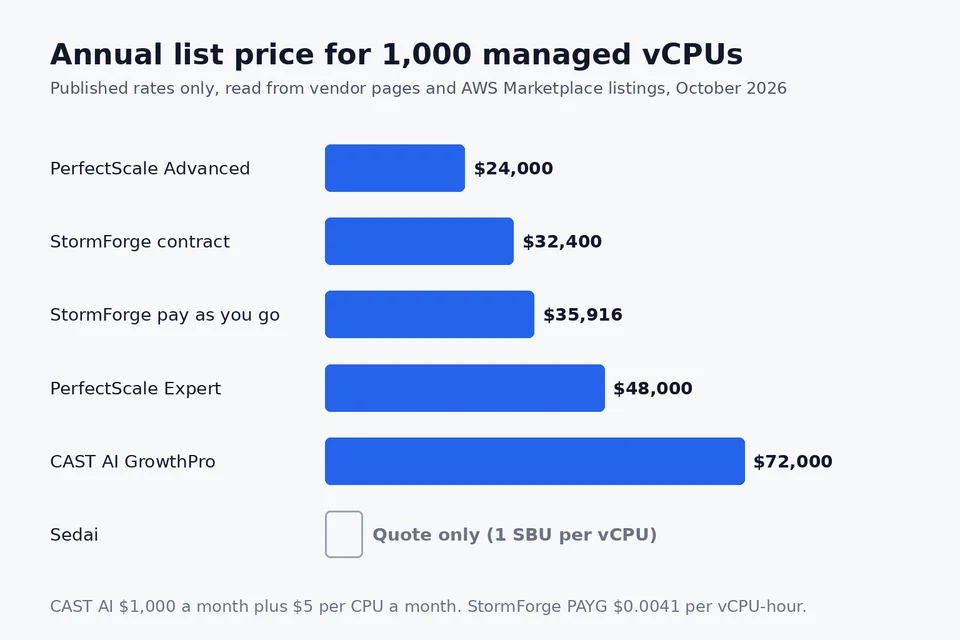
CAST AI works at the cluster layer, which is where Sedai's Kubernetes savings partly come from too: it replaces the cluster autoscaler, chooses instance types, runs Spot with fallback to on-demand, bin packs and migrates containers live. It supports EKS, GKE, AKS and Oracle Cloud. Its website quotes, but its AWS Marketplace listing prices Growth at $1,000 a month for up to 500 CPUs, GrowthPro at $1,000 a month for up to 2,000 CPUs, Enterprise at $5,000, and an hourly charge equal to $5 per CPU a month. At 1,000 CPUs on GrowthPro that is about $72,000 a year. Monitoring alone is free. It does nothing for Lambda, ECS or VMs.
See what CAST AI costsStormForge Optimize Live
Best for: Platform teams that want pod rightsizing applied in place, without changing node management
StormForge, now part of CloudBolt, does one thing Sedai also does: it learns workload usage and sets CPU and memory requests and limits, including in-place resizing without restarts. Its AWS Marketplace contract is $2,700 a month or $32,400 a year per 1,000 vCPUs, and the pay as you go listing charges $0.0041 per requested vCPU-hour, about $35,900 a year at 1,000 vCPUs running all month. It offers full optimization on one cluster for 30 days as a trial. It stays at the workload layer, so it pairs with Karpenter or the cluster autoscaler rather than replacing them, and CloudBolt lists GPU support as on the roadmap.
See what StormForge Optimize Live costsPerfectScale by DoiT
Best for: Kubernetes teams that want the lowest published per vCPU rate and a free tier to start
PerfectScale is the cheapest published Kubernetes option in this list. Its AWS Marketplace listing gives a free Community tier for up to 300,000 vCPU-hours a month, which is about 411 vCPUs running all month, then Advanced at the equivalent of $2.00 per monthly vCPU and Expert at $4.00. Automation, the public API and SSO are Expert features, so the like-for-like comparison with Sedai Autopilot is the $4.00 tier: $48,000 a year at 1,000 vCPUs. There is a 5 percent grace buffer above licensed vCPUs and no refunds. It covers Kubernetes only.
PerfectScale by DoiT compared to CostAnalystScaleOps
Best for: Kubernetes estates that need automated pod and GPU rightsizing, including self-hosted or air-gapped installs
ScaleOps automates pod rightsizing, replica settings and node consolidation, and it is one of the few vendors here that sells self-hosted and air-gapped deployments, which matters if Sedai's SaaS model is the blocker. Its AWS Marketplace listing prices a ScaleOps Platform Fee of $4,167 a month or $50,000 a year, plus a metered fee of $9.00 per vCPU, but the listing does not say whether the $9 is per month or per year. That difference decides whether 1,000 vCPUs cost about $59,000 or $158,000 a year, so ask before you compare. Published customer results include Outbrain at 40 percent or more.
See what ScaleOps costsPointFive
Best for: Enterprises that want waste found across cloud, Snowflake and Databricks and fixed with approval, rather than live tuning
PointFive is the competitor buyers most often put beside Sedai when they want an agent to fix waste. The difference is where the work happens. Sedai tunes running workloads continuously; PointFive detects waste across the estate, with more than 500 detections by its own count, and turns it into fixes routed through Jira, Slack and ServiceNow or applied with write permissions you grant. Its AWS Marketplace contract is $70,500 a year up to $3 million of annual cloud spend and $140,000 up to $7 million, with no refunds. Our PointFive pricing breakdown has the band math.
PointFive compared to CostAnalystSpot Ocean by Flexera
Best for: Container fleets on EKS, ECS, AKS and GKE that run heavily on Spot capacity
Ocean manages container infrastructure for you: it picks and scales nodes, bin packs, keeps headroom, rightsizes and fills capacity from Spot first, then reserved capacity and Savings Plans, before on-demand. It covers ECS as well as EKS, AKS and GKE, which CAST AI does not. Spot.io now redirects to Flexera, which completed the acquisition from NetApp in March 2025 and announced the ProsperOps acquisition in January 2026. No price is published.
Spot Ocean by Flexera compared to CostAnalystAWS Compute Optimizer and Cost Optimization Hub
Best for: Every AWS team, as the free baseline any Sedai quote has to beat
Before you pay anyone to tune Lambda memory or EC2 sizes, turn this on. Compute Optimizer recommends sizes for EC2 instances, Auto Scaling groups, EBS volumes, Lambda functions, ECS services on Fargate and RDS from your own utilization, and Cost Optimization Hub collects those and other savings in one list. It changes nothing on its own. The useful test for a Sedai proof of concept is how much it saves beyond what these free recommendations already show.
See what AWS Compute Optimizer and Cost Optimization Hub costsCostAnalyst
Best for: Teams that want waste and its owner shown read-only across cloud and SaaS, at a published price
We are the read-only option. CostAnalyst reads AWS, Azure and Google Cloud billing exports plus SaaS spend, shows idle and oversized resources, untagged spend and commitment gaps, ranks them in dollars and attaches each one to the team that owns it. Nothing in your environment changes, which is why security reviews are short. Plans start at $59 a month billed yearly and are on the pricing page. If you later buy Sedai or a Kubernetes specialist, our numbers give you an independent check on the savings it claims.
See how CostAnalyst worksHow to choose
Pick by the problem you actually have
Most of your compute is Kubernetes
Price PerfectScale, StormForge and CAST AI at your vCPU count first. At 1,000 vCPUs they list at $24,000 to $72,000 a year, and you can hold any Sedai quote against those numbers.
Lambda, ECS and VMs matter as much as clusters
Shortlist Sedai and IBM Turbonomic, the two that act across VMs and containers. Ask both to run a paid pilot on the same services over the same 30 days.
Security will not approve write access yet
Start read-only. AWS Compute Optimizer is free, and CostAnalyst shows waste with an owner from $59 a month. Revisit autonomy once you know what the savings are worth.
You need SaaS-free or air-gapped deployment
ScaleOps sells self-hosted and air-gapped installs, and PerfectScale Expert supports self-hosting. Sedai is SaaS.
The waste is spread across data platforms too
Put PointFive beside Sedai. It covers Snowflake and Databricks detection and prices by total cloud spend instead of vCPUs.
You keep Sedai but want an independent check
Track spend, idle resources and savings yourself from the billing export so the renewal is judged on your numbers, not the vendor dashboard. CostAnalyst does that read-only from $59 a month.
Questions buyers ask
Sedai alternatives, answered
What are the best Sedai alternatives?
The best Sedai alternatives are IBM Turbonomic for automated resourcing across VMs and Kubernetes, CAST AI, StormForge Optimize Live, PerfectScale and ScaleOps for Kubernetes-only automation, PointFive for waste detection with approved fixes, and AWS Compute Optimizer or CostAnalyst if you want the savings shown read-only. PerfectScale, StormForge and CAST AI publish per vCPU or per CPU rates; Sedai does not.
Who are Sedai competitors?
Sedai competes with IBM Turbonomic on autonomous resourcing across VMs and containers, with CAST AI, ScaleOps, StormForge and PerfectScale on Kubernetes optimization, with Spot Ocean by Flexera on container infrastructure, and with PointFive on agentic waste remediation. The free AWS Compute Optimizer is the baseline all of them are measured against.
How much does Sedai cost?
Sedai does not publish a price. Its pricing FAQ says it charges 1 Sedai Billing Unit for each vCPU the platform manages, on a fixed annual commitment with no overage penalty, so extra usage is billed at the same rate. Its AWS Marketplace listing offers a 30-day proof of concept for a one-time $1 activation fee, and the production contract is a private offer.
Is there a cheaper alternative to Sedai?
For Kubernetes, yes, on published rates. At 1,000 vCPUs PerfectScale Advanced lists at about $24,000 a year, StormForge Optimize Live at $32,400 on contract and PerfectScale Expert, the automated tier, at $48,000. AWS Compute Optimizer is free for recommendations. Sedai quotes, so the only way to know is to price your own vCPU count against those figures.
Sedai vs CAST AI, which is better?
Choose CAST AI if your spend is mostly Kubernetes and the savings are in nodes: autoscaling, instance choice, Spot and bin packing, at $1,000 a month plus $5 per CPU. Choose Sedai if a large share of spend runs on Lambda, ECS, Fargate or VMs, which CAST AI does not optimize, and you want one autonomous platform across all of them.
Sedai vs Turbonomic, how do they differ?
Both automate resourcing across VMs and containers with approval or full automation. Turbonomic grew from on-premises virtualization and prices per managed virtual server, $37,909.82 a year per 200 on AWS Marketplace. Sedai started with serverless and Kubernetes in the cloud, prices per managed vCPU and adds Lambda, Databricks and AI agent tuning.
Does Sedai offer a free trial?
Yes, in practice. Sedai's AWS Marketplace listing offers a POC Trial Offer: full-feature access for a 30-day proof of concept for a one-time $1 activation fee, after which you contact sales for a production contract. The listing says Sedai does not currently offer refunds.
Is Sedai safe to run in production?
Sedai says it makes changes in gradual steps with constant safety checks, holds eight U.S. patents on autonomous action and has never caused an incident; those are vendor claims. The practical safeguard is the Copilot mode, where each change needs one-click approval. Run Copilot through the proof of concept and move only proven workloads to Autopilot.
Is there a read-only alternative to Sedai?
Yes. AWS Compute Optimizer and Cost Optimization Hub give free rightsizing and idle resource recommendations without changing anything, and CostAnalyst shows idle, oversized and untagged spend across AWS, Azure, Google Cloud and SaaS with the owning team attached, read-only, from $59 a month. Your engineers make the change.
What should I ask Sedai before signing?
Ask the price per Sedai Billing Unit at your vCPU count and term, how vCPUs are counted for Lambda, Fargate and VMs, how far the commitment can be lowered at renewal, which workloads stay in Copilot by default, what data leaves your account, and whether the $1 proof of concept savings will be measured against a baseline you both sign.
See your savings in dollars
Upload your cloud billing export and get a prioritized savings plan. Money never moves. Create your account and get started.