Turbonomic Pricing and IBM Turbonomic Cost per Managed Virtual Server on AWS Marketplace
By the CostAnalyst team
projected this month if unattended
Spend by team
Budget forecast
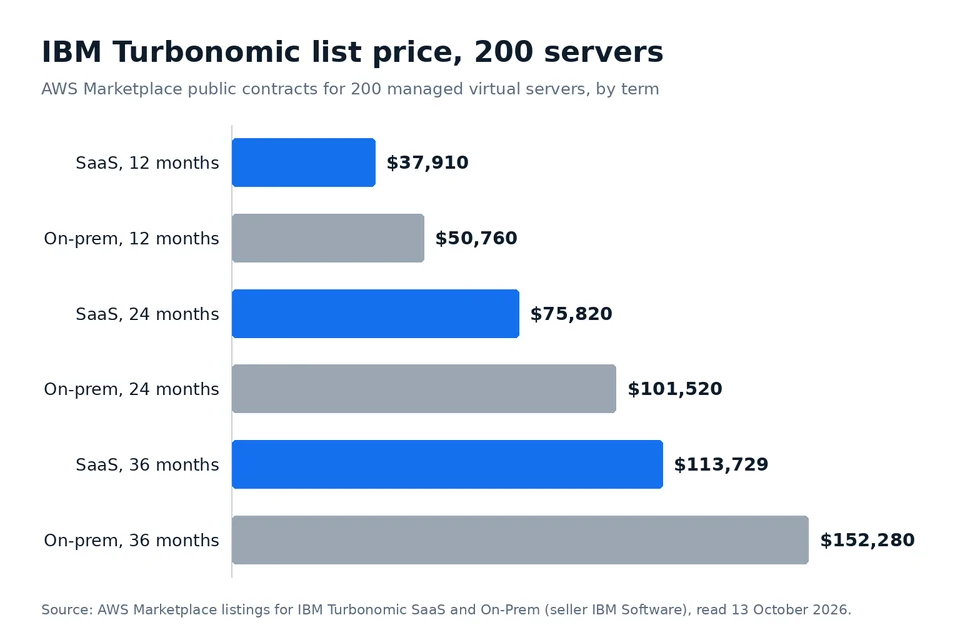
IBM Turbonomic costs $37,909.82 a year for 200 managed virtual servers on its public AWS Marketplace SaaS contract, which works out to $189.55 per server per year or about $15.80 a month. The self-hosted edition lists at $50,760 for the same 200 servers. IBM's own pricing page shows no price at all, only a quote form and a 30-day trial.
Every figure on this page was read on 13 October 2026 from two places: ibm.com/products/turbonomic/pricing, and the pricing data behind IBM's three AWS Marketplace listings (IBM Turbonomic SaaS, IBM Turbonomic On-Prem and the bring-your-own-license listing), all sold under the seller name IBM Software. The Marketplace contracts are public offers that any AWS account can accept, which makes them the only first-party list prices IBM publishes for the product. They are the anchor you negotiate from, not what a 2,000-server estate will pay.
How much does IBM Turbonomic cost?
Turbonomic is licensed per managed virtual server, sold in a block of 200. The SaaS block is $37,909.82 for 12 months and the on-prem block is $50,760. Both listings also offer 24 and 36 month terms, and neither one rewards you for the longer commitment: the multi-year prices are the one-year price multiplied by two and by three, to within two cents.
| Listing | 12 months | 24 months | 36 months | Per server, per year |
|---|---|---|---|---|
| IBM Turbonomic SaaS, 200 managed virtual servers | $37,909.82 | $75,819.62 | $113,729.47 | $189.55 |
| IBM Turbonomic On-Prem, 200 managed virtual servers | $50,760.00 | $101,520.00 | $152,280.00 | $253.80 |
| SaaS overage, per managed virtual server | $22.60 per unit, metering period not stated | See below | ||
| Bring your own license (deploy to your own EKS cluster) | No AWS price; billed through your IBM agreement | |||
Three details in that card are easy to miss. The self-hosted edition costs 33.9% more than SaaS for the same server count, the reverse of what most buyers expect when they offer to run the software themselves. There is no multi-year discount on the public offer, so a three-year term only buys price protection. And the refund term is blunt on every listing: all orders are non-cancellable, all fees are non-refundable, and on a multi-year subscription you agree to pay the annual fee for each year of the term.
What does Turbonomic cost per VM per month?
At list, Turbonomic SaaS costs $15.80 per managed virtual server per month and the on-prem edition costs $21.15, both billed annually in advance. Software directories quote figures such as $18.75 a month without naming the unit or the edition. That number sits between the two real list rates, so treat it as a rough average and price your own estate from the contract instead.
The per-server rate matters less than the count it is multiplied by. A server that Turbonomic can see but that you never intended to optimize, a build agent, a stopped instance, a sandbox account connected by accident, is still a candidate for the license count. Scope the targets before the quote, not after the true-up.
What counts as a managed virtual server?
IBM's pricing page uses the term Managed Virtual Servers (MVS) and does not define it. In practice it is a virtual machine or cloud instance that Turbonomic discovers through a connected target and manages. What the public pages do not settle is how Kubernetes nodes, container pods, RDS instances and other platform services convert into servers, and licensing advisers disagree with each other on that point.
This is the question that moves the bill more than any discount. The same pricing page lists Kubernetes optimization for EKS, AKS and GKE, plus application and database optimization for services like RDS, as things the product connects to. If a 400-node cluster counts as 400 servers, your contract doubles before you have touched a VM. Get the conversion ratios for every target type in writing, in the order form, with the names of the targets you plan to connect.
What happens above 200 servers?
The SaaS listing carries a second price: an overage dimension named IBM Turbonomic Managed Virtual Server Overage at $22.60 per unit. The listing does not say whether that is per month or per year, and the two readings are a factor of twelve apart. The table shows both, next to a straight-line estimate at the contract rate, which is the best guide to what a private offer for a larger block starts from.
| Managed virtual servers | Straight-line at $189.55 per server | One block plus overage read as monthly | One block plus overage read as annual | On-prem blocks of 200 at list |
|---|---|---|---|---|
| 200 | $37,910 | $37,910 | $37,910 | $50,760 |
| 500 | $94,775 | $119,270 | $44,690 | $152,280 (3 blocks) |
| 1,000 | $189,549 | $254,870 | $55,990 | $253,800 (5 blocks) |
| 2,000 | $379,098 | $526,070 | $78,590 | $507,600 (10 blocks) |
The monthly reading is the plausible one. At $22.60 a month an overage server costs $271.20 a year, a 43% premium over the contract rate, which is how overage is normally priced: it exists to push you into a bigger commitment. Read as annual, an overage server would cost 88% less than a contracted one, and nobody would ever buy a second block. Budget on the monthly reading until IBM confirms otherwise, and note that the public offer does not let you set a quantity, so anything past the first block is a private offer or overage.
Is IBM Turbonomic free to try?
Yes. IBM offers a 30-day trial with no credit card, described as unlimited optimization of application resources and cloud costs for AWS, Azure and GCP accounts, with an unlimited number of managed virtual servers. There is no permanent free tier. After the trial the choices are SaaS, on-premises, or the Parking Edition, a narrower SaaS product that stops and starts idle non-production workloads on schedules and policies.
Use the trial to answer the counting question with your own data. Connect the real targets, let discovery finish, and read the workload count in the license summary before you ask for a quote. Thirty days is also enough to see how many of the recommended actions your team is willing to automate, which is the number that decides whether the product pays for itself.
How does Turbonomic pricing compare to the alternatives?
Turbonomic bills on what it manages, not on what it saves and not on what you spend. That makes it cheap next to a percentage-of-spend contract on a large cloud bill and expensive on a small one. These are the public list prices for the tools buyers most often weigh it against, each read from the vendor's own page or Marketplace listing.
| Tool | What you are billed on | Public list price | Changes resources for you |
|---|---|---|---|
| IBM Turbonomic SaaS | Managed virtual servers | $37,909.82 a year for 200 | Yes |
| Kubex (formerly Densify) | vCPU tiers | From $499 a month for 500 vCPUs | Yes |
| CAST AI | Platform fee plus managed CPUs | Growth $1,000 a month plus $5 per CPU | Yes, Kubernetes |
| ScaleOps | Platform fee plus vCPUs | $50,000 a year plus $9 per vCPU | Yes, Kubernetes |
| StormForge Optimize Live | Requested vCPUs | $2,700 a month per 1,000 vCPUs | Yes, Kubernetes |
| AWS Compute Optimizer | Nothing for standard recommendations | Free, AWS only | No |
| VMware Tanzu CloudHealth | Monthly AWS spend | $45,000 a year to $150,000 of monthly spend | No |
| CostAnalyst | Tracked cloud and SaaS spend | From $59 a month | No, read-only |
The split in the last column is the real decision. Turbonomic, Kubex and the Kubernetes specialists act on infrastructure; the others tell you where the money goes and leave the change to your engineers. Our comparisons of EC2 rightsizing tools, Azure VM rightsizing tools and RDS rightsizing tools put Turbonomic next to each alternative on the workloads it is usually bought for, and the Kubernetes rightsizing tools guide covers the container side. If you only run AWS, read what the free option does first in our breakdown of AWS Compute Optimizer pricing.
What else do you pay for besides the license?
Services and your own engineers' time. IBM sells Expert Labs packages alongside the license, listed on the pricing page without prices: a planning engagement of up to 8 hours, a 40-hour build engagement delivered in virtual sessions, and an install and configure package of 40 person-hours. Reviews quoted on IBM's own Marketplace listing describe setup as the hard part, with integrations, permissions and policies across clouds and hypervisors taking time to get right.
Automation also has an operating cost. Once Turbonomic is allowed to resize and move production workloads on its own, those actions belong in your change process, with the same on-call paging and incident runbooks you use for any other change that can degrade a service. Teams that skip this step tend to switch automation back to manual approval after the first bad resize, and then pay for an automation platform they use as a recommendation list.
What should you ask IBM before signing?
- How is each target type counted: a VM, a Kubernetes node, a pod, an RDS instance, a virtual desktop? Ask for the ratios in the order form.
- Is the $22.60 overage charged per server per month or per year, and is it measured on peak or average count?
- What is the price per server at 500, 1,000 and 2,000, and does a three-year term discount it? The public offer gives no multi-year discount.
- Why is on-prem 33.9% more than SaaS at list, and does a private offer close that gap?
- Do stopped instances and non-production accounts count, and can targets be excluded from the license count?
- Given that orders are non-cancellable and non-refundable, can you start with a one-year term sized on the trial's measured count?
- Which actions will be automated on day one, and what savings does IBM expect from those alone?
Do you need Turbonomic, or do you need to see the bill?
Turbonomic earns its price when you have hundreds of workloads, an operations team ready to let software act, and a mix of data center and cloud that no single-cloud tool covers. If the problem is earlier than that, nobody can say which team owns which part of the cloud and SaaS bill, or why last month jumped, a $38,000 automation contract is the wrong first purchase.
That earlier problem is the one CostAnalyst solves. It reads your AWS, Azure and Google Cloud billing exports and your SaaS subscriptions read-only, allocates the spend to teams, flags anomalies and idle resources in dollars, and starts at $59 a month on the yearly plan. It never changes a resource. Teams that go on to buy Turbonomic keep it for a second reason: the vendor that makes the changes should not be the only one measuring the savings. You can run one billing export through the analysis before paying anything, and the plans are on the pricing page.
The short version
IBM publishes no Turbonomic price on its website. Its AWS Marketplace listings do: $37,909.82 a year for 200 managed virtual servers on SaaS, $50,760 on-prem, no multi-year discount, a $22.60 overage with the period unstated, and no refunds. That is $15.80 per server per month at list. Before you compare quotes, pin down how Kubernetes nodes and platform services are counted, because that ratio changes the total more than any negotiation will. For the sibling product in IBM's cost portfolio, see our breakdown of Apptio pricing.
See where your cloud and SaaS money is leaking
Upload your cloud billing export and see your savings in dollars. Transparent pricing, no card to start.