StormForge Pricing and Optimize Live Cost per vCPU on AWS Marketplace
By the CostAnalyst team
projected this month if unattended
Spend by team
Budget forecast
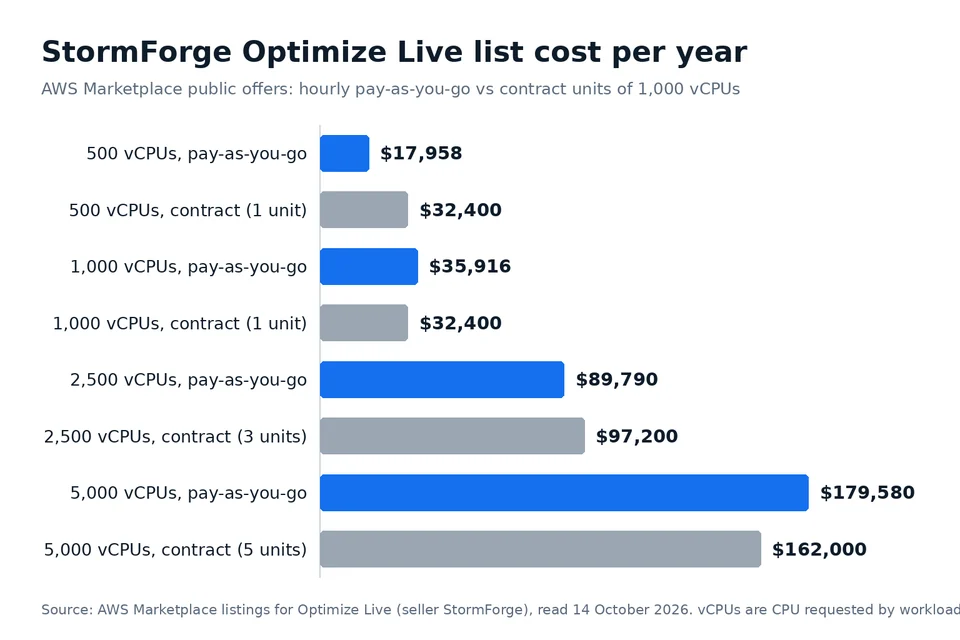
StormForge Optimize Live costs $0.0041 per requested vCPU per hour on its pay-as-you-go AWS Marketplace listing, about $2.99 per vCPU a month, or $32,400 a year per 1,000 vCPUs on the contract listing. CloudBolt, which owns StormForge, shows no price on its own site, only a 30-day trial on one cluster and a quote form.
Every StormForge figure on this page was read on 14 October 2026 from two places: the CloudBolt page that stormforge.io/pricing now redirects to, and the pricing data behind the two AWS Marketplace listings for Optimize Live, both still sold under the seller name StormForge. The Marketplace listings are public offers that any AWS account can accept, which makes them the closest thing to a list price this product has. Your negotiated price can be lower. It should not be higher.
How much does StormForge cost?
StormForge sells Optimize Live two ways on AWS Marketplace. The pay-as-you-go listing bills $0.0041 for every vCPU your workloads request, every hour, with no upfront payment and no minimum. The contract listing sells capacity in units of 1,000 vCPUs at $2,700 for one month or $32,400 for twelve.
| Listing | Unit | List price | Per vCPU, per month | Per 1,000 vCPUs, per year |
|---|---|---|---|---|
| Optimize Live, pay-as-you-go | Requested vCPU-hour, billed hourly | $0.0041 | $2.99 at 730 hours | $35,916 |
| Optimize Live, contract, 1 month | 1,000 vCPUs | $2,700 | $2.70 | $32,400 if renewed monthly |
| Optimize Live, contract, 12 months | 1,000 vCPUs | $32,400 | $2.70 | $32,400 |
| StormForge Consultation (on the contract listing) | 60-minute session | $1 | Not a product fee | |
Three things in that card are easy to miss. The annual contract carries no discount over twelve monthly terms: 12 times $2,700 is exactly $32,400, so a one-year commitment buys you nothing but a single invoice. Pay-as-you-go costs 10.9% more per vCPU than the contract at full use, which is a small premium for having no commitment at all. And the contract listing allows quantity selection, so you can buy two or five units of 1,000, something the ScaleOps listing does not permit.
What does StormForge cost per vCPU?
At list, StormForge costs $2.70 per vCPU per month on a contract and about $2.99 on pay-as-you-go. That is $32.40 and $35.92 per vCPU per year. Both numbers apply to the CPU your workloads request, not to the CPU your nodes provide, and that distinction changes the bill more than the choice between the two listings.
The pay-as-you-go dimension is described as billed hourly on aggregate workload CPU requests, and StormForge's own documentation says the count covers requested CPU cores per cluster including replicas created by the horizontal pod autoscaler. A cluster with 1,000 node vCPUs where pods request 600 of them is a 600 vCPU customer. Tools that bill on node or managed CPU would count the same cluster as 1,000.
There is a second consequence that works in your favor. Optimize Live exists to lower CPU requests, so on the hourly listing its own fee falls as it does its job. If rightsizing takes your requests from 600 vCPUs to 420, the monthly charge drops from about $1,796 to about $1,257. A contract bought in 1,000 vCPU units does not shrink the same way.
Should you choose pay-as-you-go or the contract?
The break-even between the two listings is about 902 requested vCPUs per 1,000 vCPU unit. Below that average, pay-as-you-go is cheaper than one contract unit. Above it, the contract wins, but only by the 10.9% gap. Because the contract comes in whole units of 1,000, the cheaper option flips as you grow.
| Average requested vCPUs | Pay-as-you-go, per year | Contract units needed | Contract, per year | Cheaper at list |
|---|---|---|---|---|
| 100 | $3,592 | 1 | $32,400 | Pay-as-you-go by $28,808 |
| 300 | $10,775 | 1 | $32,400 | Pay-as-you-go by $21,625 |
| 500 | $17,958 | 1 | $32,400 | Pay-as-you-go by $14,442 |
| 1,000 | $35,916 | 1 | $32,400 | Contract by $3,516 |
| 2,500 | $89,790 | 3 | $97,200 | Pay-as-you-go by $7,410 |
| 5,000 | $179,580 | 5 | $162,000 | Contract by $17,580 |
Read the 2,500 row twice. A team between two unit sizes pays for 500 vCPUs of unused contract capacity, and the hourly listing comes out ahead even at that scale. Unless a private offer prices partial units or discounts volume, the public contract only makes sense when your requested CPU sits close to a round thousand and is not expected to fall. Since the product's purpose is to make that number fall, start on the hourly listing and move to a contract after the first month of data.
Is StormForge free to try?
Yes. CloudBolt offers a free trial that it describes as full optimization on one cluster for 30 days. There is no permanent free tier. The product needs about seven days of metrics before its first recommendations are worth acting on, so a 30-day trial gives you roughly three weeks of usable results.
Use the trial to measure the one number that sets your price: total requested CPU across the clusters you plan to connect, including autoscaled replicas at peak. Then watch how far it drops once recommendations are applied. That before and after pair tells you both what you would pay and what you would save, which is everything a budget request needs.
Does StormForge publish pricing on its website?
No. The address stormforge.io/pricing now redirects to a CloudBolt product page for StormForge that carries no rate, no unit and no tier table. It shows a trial button, a claim of up to 80% savings in 30 days and customer references including Acquia, which reports a 65% reduction in web node footprint. CloudBolt bought StormForge on 31 March 2025, and the Marketplace listings are the only public source of the numbers above.
That is why software directories describe StormForge as custom pricing or quote only. It is the same pattern we found with CAST AI and ScaleOps: the vendor site says to talk to sales while the vendor's own Marketplace listing states the rate. If you are comparing the three, our ScaleOps vs StormForge comparison sets the rate cards side by side.
How does StormForge pricing compare to ScaleOps and CAST AI?
StormForge is the cheapest of the three automated rightsizing vendors at list for small and mid-size clusters, and the only one with no platform fee. The units differ, so compare total cost at your size instead of the headline rate. ScaleOps and CAST AI figures below were read from their AWS Marketplace listings in September 2026.
| Vendor | Platform fee | Usage rate | What the unit counts | Scope |
|---|---|---|---|---|
| StormForge Optimize Live | None | $0.0041 per vCPU-hour, or $32,400 a year per 1,000 vCPUs | CPU requested by workloads | Pod rightsizing, works with the horizontal pod autoscaler |
| ScaleOps | $50,000 a year ($4,167 a month) | $9.00 per vCPU, metering period not stated | vCPU, per the listing | Pod rightsizing, node and spot optimization, GPU |
| CAST AI Growth | $12,000 a year ($1,000 a month) | About $5.00 per managed CPU per month | CPUs on managed nodes | Autoscaling, spot automation, bin packing, pod rightsizing |
At 500 requested vCPUs, StormForge on the hourly listing comes to about $17,958 a year. ScaleOps starts at $50,000 before any metered charge. CAST AI Growth with 500 managed CPUs is about $42,000. The gap narrows as clusters grow and it reverses on scope: StormForge rightsizes pod requests and does not manage nodes or spot capacity, so a team that needs both will buy a second tool or use Karpenter alongside it. Our guide to Kubernetes rightsizing tools covers which products do which job, and ScaleOps pricing and CAST AI pricing break down the other two cards.
Six questions to ask before you sign
- Is billing measured on requested CPU, and are HPA replicas counted at peak or as an hourly average?
- Can a contract be sized in units smaller than 1,000 vCPUs, or combined with hourly billing for the remainder?
- What is the rate at 2,000, 5,000 and 10,000 vCPUs on a private offer? The public contract shows no volume or annual discount.
- If rightsizing lowers our requested CPU mid-term, does a contract adjust down?
- What are the refund terms? The pay-as-you-go listing says SaaS subscription fees are non-refundable, and the contract listing says only that terms and conditions apply.
- The trial covers one cluster. What does the fee look like across every cluster we would connect in production?
Get the answers in the order form, and record the term and notice period somewhere a renewal cannot slip past you. Marketplace contracts renew quietly, so finance teams usually keep them in contract management software that tracks renewal dates alongside the rest of the vendor paper.
Do you need StormForge, or do you need to see the bill first?
StormForge earns its fee when you run enough workloads that nobody can tune requests by hand and your platform team is ready to let software change them. If the problem is earlier than that, you cannot say which team or product owns which share of the Kubernetes and cloud bill, automation is the second purchase, not the first.
CostAnalyst solves the earlier problem. It reads your AWS, Azure and Google Cloud billing exports and SaaS subscriptions read-only, allocates spend to teams, flags idle and oversized resources in dollars, and starts at $59 a month on the yearly plan. It never changes a workload. Teams that go on to buy a rightsizing tool keep it for a second reason: the vendor that changes your requests should not be the only one reporting the savings. You can run one billing export through the analysis before paying anything, and the plans are on the pricing page.
The short version
CloudBolt publishes no StormForge price. The AWS Marketplace listings do: $0.0041 per requested vCPU-hour with no minimum, or $2,700 a month and $32,400 a year per 1,000 vCPUs, with no annual discount. That is $2.70 to $2.99 per vCPU per month at list, billed on what workloads request and not on node size. Below about 900 requested vCPUs, and between contract unit sizes, the hourly listing is cheaper. For the wider field, see ScaleOps alternatives and the comparison of CAST AI vs Kubecost.
See where your cloud and SaaS money is leaking
Upload your cloud billing export and see your savings in dollars. Transparent pricing, no card to start.