Ternary Pricing and What Ternary Costs a Year on AWS Marketplace
By the CostAnalyst team
projected this month if unattended
Spend by team
Budget forecast
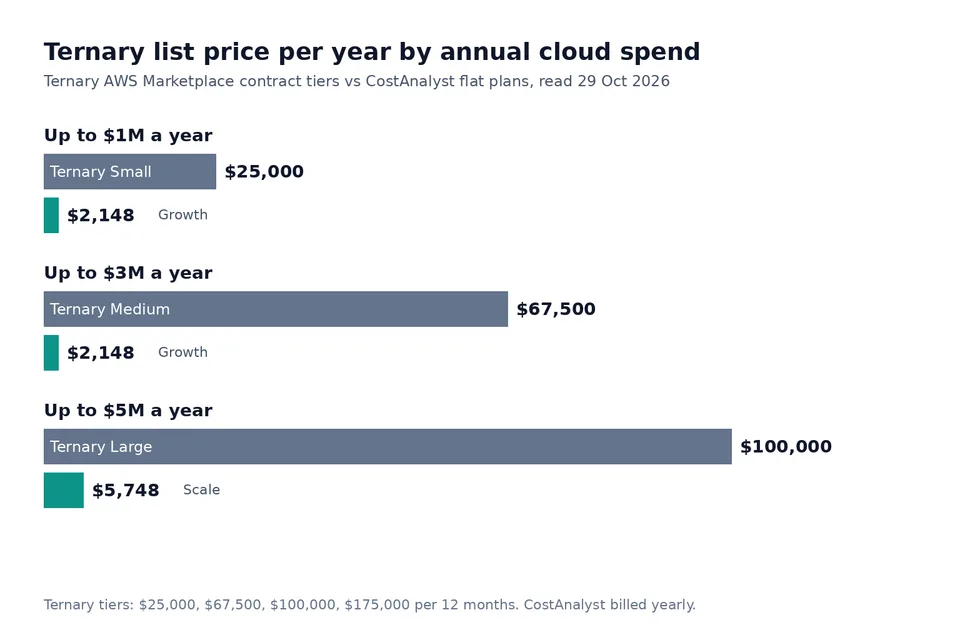
Ternary costs $25,000 for 12 months for up to $1 million of annual multicloud spend, $67,500 for up to $3 million, $100,000 for up to $5 million and $175,000 above that, according to Ternary's own AWS Marketplace listing. There is no per-user fee, and the listing says every tier gets the same platform. The only thing that changes is how much annual spend the contract covers.
ternary.app shows no price and its pricing URL returns a not-found page, which is why most buyers assume Ternary is quote-only. It is not entirely. The Multicloud FinOps Platform listing sold by Ternary on AWS Marketplace prints a four-row rate card. We read it on 29 October 2026. The arithmetic below is ours and is shown so you can redo it with your own number.
How much does Ternary cost?
Ternary prices by the annual multicloud spend you put under management, as a fixed fee for a 12-month contract. Four tiers are listed. Your tier is the smallest one whose spend ceiling covers your cloud, SaaS and AI bill for the year, and the fee does not move with seats, accounts or dashboards.
| Ternary tier | Annual spend covered | Price per 12 months | Share of the spend ceiling |
|---|---|---|---|
| Small | Up to $1,000,000 | $25,000 | 2.5% |
| Medium | Up to $3,000,000 | $67,500 | 2.25% |
| Large | Up to $5,000,000 | $100,000 | 2.0% |
| Extra Large | Above the Large ceiling (no upper limit stated) | $175,000 | 3.5% at $5M, 1.75% at $10M |
The listing says the tiers differ only in the spend they cover. Its highlights add that pricing carries no extra charges for data overage or professional services. The Extra Large row has a blank description in the price table, so the wording about "spend above these thresholds" comes from the listing's own summary text, and the ceiling is something to confirm in writing.
What does Ternary cost for a small company?
The Small tier is a minimum, not a slope. A company that spends $1 million a year across cloud and SaaS pays 2.5% of it, but a company spending $300,000 a year pays $25,000 for the same tier, which is 8.3% of its bill. Below roughly $500,000 a year the percentage climbs fast, and that is the range where a tool has to find real waste just to cover its own price.
| Annual spend under management | Ternary tier | Per year at list | Share of spend |
|---|---|---|---|
| $200,000 | Small | $25,000 | 12.5% |
| $500,000 | Small | $25,000 | 5.0% |
| $1,000,000 | Small | $25,000 | 2.5% |
| $1,100,000 | Medium | $67,500 | 6.1% |
| $3,000,000 | Medium | $67,500 | 2.25% |
| $3,100,000 | Large | $100,000 | 3.2% |
| $5,000,000 | Large | $100,000 | 2.0% |
| $5,100,000 | Extra Large | $175,000 | 3.4% |
Look at the steps. Growing from $1.0 million to $1.1 million of spend raises the Ternary fee from $25,000 to $67,500, a 170% increase for a 10% rise in spend. The same cliff appears at $3 million and at $5 million. If your spend sits just under a ceiling, a good deal is a ceiling written with headroom, not a lower headline price.
How is Ternary priced, by spend or by user?
By spend. Ternary does not charge per seat, per cloud account or per integration on its Marketplace card. That suits a finance team that wants every engineer to see cost data, and it means the price is predictable once your tier is fixed. It also means a rise in cloud or AI spend moves you up a tier whether or not you use more of the product.
The listing states that you buy a set quantity of use for the contract term, and that entitlements expire if you do not renew or replace the contract before it ends. It also notes that moving to a higher tier as spend grows needs the timing confirmed with the vendor. Nothing on the page says whether a mid-term upgrade is prorated, which is the first question to put to Ternary.
What is included in every Ternary tier?
Everything. The listing says all four tiers get the same platform: one ledger across cloud, SaaS, AI and on-premise spend, token-level AI attribution, and actuals mapped to your general ledger that feed an ERP. Ternary's own site describes the product as technology investment intelligence for finance, ingesting AWS and GCP billing data plus direct vendor invoices and token telemetry from AI providers, with no agents and no custom code.
That finance-facing scope is the reason for the price. Ternary is built so that a controller can close the books on technology spend, which is a different job from a tool that helps an engineer delete idle volumes. If you need GL-mapped actuals and AI invoice reconciliation, the fee buys features that flat-priced alternatives do not have. If you do not, you are paying for scope you will not use.
Is there a free trial or a refund?
The Marketplace listing mentions no free trial. Its refund line says only to contact [email protected], and the contract is marked as not a standard contract, so the terms sit in Ternary's own end user licence agreement. Buyers on a five-figure commitment should get the refund and termination language in the order form before the first invoice, not after it.
Can you buy Ternary through AWS Marketplace?
Yes, and for many buyers that is the real price advantage. A Marketplace contract can draw down an existing AWS commitment, so the $25,000 to $175,000 may be spent from budget your company has already agreed with AWS. Ternary says it can also be bought directly. Ask whether the direct price and the Marketplace price match, because sellers sometimes list one and discount the other.
How does Ternary pricing compare with other cloud cost tools?
At $1 million a year of cloud spend, Ternary's $25,000 list price is the highest of the tools that publish a number. The table uses the public price of each vendor as we read it for our own pricing guides, and it assumes your spend is on AWS where the vendor prices by AWS spend.
| Tool | How it prices | List price at $1 million a year ($83,333 a month) |
|---|---|---|
| Ternary | Fixed fee by annual spend tier, 12-month contract | $25,000 a year |
| CloudZero | $209 per $1,000 of monthly AWS spend on an annual term | About $17,400 a year |
| Vantage | $200 a month plus 1% of monthly cloud costs over $20,000 | $10,000 a year |
| CostAnalyst | Flat plans by tracked spend, cloud and SaaS together | $2,148 a year (Growth, to $250,000 a month) |
Price is not the whole comparison and we would rather say so. Ternary reads your billing datasets and vendor invoices directly, supports AI token telemetry and maps spend to a general ledger. CostAnalyst works from the billing exports and SaaS subscription lists you provide, covers AWS, Azure and Google Cloud plus seat-based SaaS, and reports savings in dollars with anomaly alerts, but it does not post to an ERP. For the other pricing models in the category, see CloudZero pricing, Vantage pricing and Finout pricing.
Is Ternary worth the price?
At $3 million of annual spend or more, with a finance team that wants GL-mapped technology actuals, probably yes: 2.25% or less of the spend you manage is a normal range for a platform with that scope. Below $1 million, and especially below $500,000, the minimum is hard to defend unless audit-ready allocation is a hard requirement. A team that mainly wants to find waste, track subscriptions and get alerts can do it for a few thousand dollars a year.
The vendor-agnostic test is simple. Divide the fee by the savings you can document in the first 12 months. A tool that costs 2.5% of your spend needs to cut 2.5% just to break even, before staff time. The honest way to check is to run one of your own billing exports through a cheaper tool first and see how much waste is visible. Our one-time analysis does that with a single file.
What to ask Ternary before you sign
- Which tier does our spend fall in once SaaS and AI invoices are counted, and are those counted at all?
- Is the tier ceiling measured on trailing 12 months, forecast spend, or calendar year, and what happens the month we pass it?
- If we upgrade mid-term, is the difference prorated or does the new tier start a fresh 12 months?
- What is the Extra Large spend ceiling, and is $175,000 fixed above it?
- Are the Marketplace price and the direct price the same, and which draws down our AWS commitment?
- What are the refund and early-termination terms in the end user licence agreement?
The short version
Ternary pricing is public on AWS Marketplace even though ternary.app hides it: $25,000, $67,500 and $100,000 a year for up to $1 million, $3 million and $5 million of annual multicloud spend, and $175,000 above that. It is a fixed fee with no per-user charge and the same product at every tier, but it steps up sharply at each ceiling and the Small tier is a $25,000 minimum. If you want cloud and SaaS spend in one view on a flat price that does not track your spend, CostAnalyst's plans start at $59 a month billed yearly. If the vendor invoices Ternary ingests are also what your payables team keys in by hand, accounts payable automation that reads those same invoices is the next system to look at.
See where your cloud and SaaS money is leaking
Upload your cloud billing export and see your savings in dollars. Transparent pricing, no card to start.