Vantage Pricing and What Vantage Costs Above $20,000 a Month of Cloud Spend
By the CostAnalyst team
projected this month if unattended
Spend by team
Budget forecast
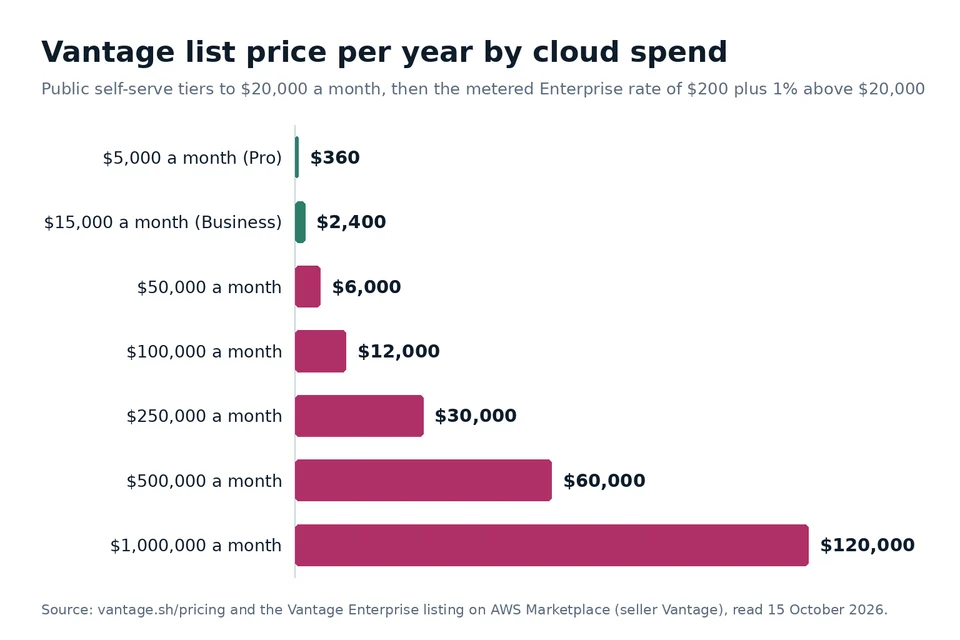
Vantage costs nothing up to $2,500 of tracked cloud spend a month, $30 a month on Pro up to $7,500, and $200 a month on Business up to $20,000. Above $20,000 a month you move to Enterprise, which Vantage's own AWS Marketplace listing prices at $200 a month plus 1% of your monthly cloud costs over $20,000, or a fixed-rate quote with a 12-month minimum.
Every Vantage figure here was read on 15 October 2026 from two places: the vantage.sh pricing page, including the answers inside its FAQ, and the pricing data behind Vantage's two AWS Marketplace listings, both sold under the seller name Vantage. The self-serve tiers are easy to find. What most pricing write-ups miss is the Enterprise rate, the user limits on each tier, and what happens the month your bill crosses a ceiling. Those three things decide what you will actually pay.
How much does Vantage cost?
Vantage prices by tracked cloud spend, meaning the monthly total of the cloud and SaaS provider costs you connect, not by users or resources. There are three self-serve tiers with a published price and an Enterprise tier for anyone above $20,000 a month. Prices exclude sales tax.
| Tier | List price | Tracked cloud spend | Users | Data retention | Trial |
|---|---|---|---|---|---|
| Starter | Free | Up to $2,500 a month | 3 | 6 months | Not needed |
| Pro | $30 a month | Up to $7,500 a month | 5 | 6 months | 14 days |
| Business | $200 a month | Up to $20,000 a month | 10 | 12 months | 14 days |
| Enterprise | $200 a month plus 1% above $20,000, or a fixed quote | Unlimited | Unlimited | Unlimited | Extended evaluation with sales engineering |
Two details in that table contradict what several comparison sites still say. First, users are not unlimited on every tier: the current pricing grid caps Starter at 3 team members, Pro at 5 and Business at 10, and only Enterprise is unlimited. Second, Pro and Business add Autopilot for AWS Savings Plans and virtual tagging, which Starter does not have. If your team has six people who need to see costs, Pro is already too small regardless of spend.
What does Vantage cost above $20,000 a month?
Above $20,000 of monthly cloud spend, Vantage charges $200 a month plus 1% of everything over $20,000 on its metered Enterprise plan. At $100,000 a month of cloud spend that is $1,000 a month, or $12,000 a year. The alternative is a fixed-rate annual quote from sales with a 12-month minimum commitment.
Vantage's pricing FAQ describes the metered route as signing up immediately and paying "a percentage of your cloud spend, metered each month", without naming the percentage. The Vantage Cloud Cost Platform Enterprise listing on AWS Marketplace names it: a $200 monthly subscription described as "$200/month then 1% of total monthly cloud costs over $20,000", plus a usage dimension of $0.01 for each additional dollar of tracked spend above $20,000. Here is what that works out to.
| Monthly cloud spend tracked | Vantage tier | Per month at list | Per year at list | Share of cloud spend |
|---|---|---|---|---|
| $5,000 | Pro | $30 | $360 | 0.60% |
| $15,000 | Business | $200 | $2,400 | 1.33% |
| $20,000 | Business | $200 | $2,400 | 1.00% |
| $50,000 | Enterprise, metered | $500 | $6,000 | 1.00% |
| $100,000 | Enterprise, metered | $1,000 | $12,000 | 1.00% |
| $250,000 | Enterprise, metered | $2,500 | $30,000 | 1.00% |
| $1,000,000 | Enterprise, metered | $10,000 | $120,000 | 1.00% |
Notice the curve. Below $20,000 Vantage is one of the cheapest paid tools in the category. Above it, the metered plan settles at almost exactly 1% of your cloud bill and keeps scaling with it, so a company spending $1 million a month on cloud pays six figures at list. That is the point where the fixed-rate quote is worth asking for, because a flat annual price stops your tooling cost from rising every time your infrastructure grows.
There is a third number on the standard Vantage Marketplace listing that nobody explains. Next to Pro at $30 and Business at $200 it carries a "Vantage Custom" dimension at $1,000 a month, described as tracking "$50k+ in monthly costs", with no upper limit stated. At $100,000 a month that matches the metered Enterprise price exactly. Above it, the two listings give different answers, so if you are buying through AWS, ask Vantage in writing which dimension applies to your spend and whether $1,000 is a floor or a flat price.
What happens if your cloud costs exceed your Vantage tier?
If your costs pass your tier's ceiling, Vantage obscures your cost data in the console until you upgrade. It enforces the limit on the previous calendar month's total accrued cost, so a January bill over $7,500 locks a Pro account's data in February. Nothing is deleted, but you cannot see it without moving up.
For a growing startup this is the practical trap. A team on Pro at $6,000 a month that launches a new environment can find itself over the $7,500 line and jump from $30 to $200 a month, a sevenfold increase in the tool bill caused by a 25% increase in the cloud bill. The same thing happens at $20,000, where Business hands over to metered Enterprise. Upgrades mid-term are charged immediately for the prorated difference, then at the full new price from the next renewal date.
How much do Autopilot and the FinOps Agent cost?
Both are priced on savings, not on spend. Autopilot for AWS Savings Plans charges 5% of the savings it finds, and nothing if it finds none. Vantage's own example: on a $10,000 monthly EC2 bill, Autopilot buys Compute Savings Plans that save $3,000 a month, so the fee is $150 and you keep $2,850.
Existing Savings Plans are not charged, and for RDS, ElastiCache, Redshift and OpenSearch, Autopilot only recommends a Reserved Instance purchase and links you to the AWS console, with no fee. The Automated FinOps Agent, which is listed on Enterprise only, charges 10% of realized savings from actions it takes itself, such as deleting unattached EBS volumes, obsolete snapshots or idle load balancers. Savings are measured as the reduction in your cloud costs after the action.
Ten percent of realized savings sounds small until you add it to the base fee. A $100,000 a month account paying $1,000 a month for Enterprise, $150 a month for Autopilot and 10% of $4,000 of monthly cleanup savings pays about $1,550 a month, or $18,600 a year, before any negotiation. That total is the figure to put in the budget request, not the tier price alone.
Does Vantage add charges to your AWS bill?
Slightly. Vantage calls the AWS Cost Explorer API, which AWS bills at $0.01 per request, and only when someone views accrued costs in the Vantage console. Vantage says customers typically see less than $1 a month of extra charges. That is negligible, but your FinOps team will see the line item and it helps to know where it comes from.
Can you buy Vantage through AWS Marketplace?
Yes. Vantage accepts credit card, AWS Marketplace, Azure Marketplace and direct invoicing, and you can switch a card subscription to a Marketplace one by emailing Vantage support. There are two AWS listings, both sold by Vantage, and both state "No refunds".
| AWS Marketplace listing | Dimension | Description on the listing | Price |
|---|---|---|---|
| Vantage Cloud Cost Platform | Vantage Pro | Track up to $7,500 in monthly costs | $30 per month |
| Vantage Cloud Cost Platform | Vantage Business | Track up to $20,000 in monthly costs | $200 per month |
| Vantage Cloud Cost Platform | Vantage Custom | Track $50k+ in monthly costs | $1,000 per month |
| Vantage Cloud Cost Platform, Enterprise | Vantage Enterprise | $200 a month, then 1% of total monthly cloud costs over $20,000 | $200 per month plus usage |
| Vantage Cloud Cost Platform, Enterprise | Additional tracked spend | Per $1 above $20,000 | $0.01 |
Buying through AWS lets the subscription count against an existing AWS commitment, which is often the deciding factor for a finance team. The trade-off is the refund line. A card subscription can be cancelled and runs to the end of the current term, then drops to Starter. A Marketplace purchase offers no refund on what you have already committed.
How does Vantage pricing compare with other cloud cost tools?
At $100,000 a month of cloud spend, Vantage's metered list price of $12,000 a year sits in the middle of the tools that publish a number. It is well below the contract tools sold to large enterprises and well above the flat-priced self-serve options. The table uses each vendor's own public price, read on the dates shown in our separate pricing breakdowns.
| Tool | How it prices | List price at $100,000 a month of cloud spend |
|---|---|---|
| Vantage | Free to $2,500, $30 and $200 tiers, then $200 plus 1% above $20,000 | $12,000 a year |
| CloudZero | $209 per $1,000 of monthly AWS spend on an annual term | $20,900 a year |
| Finout | Flat tiers by annual AWS spend ($12,000 to $500,000, $40,000 to $2 million) | $40,000 a year (Pro, since $1.2 million a year exceeds Business) |
| IBM Cloudability | Annual contract tiers by annual cloud spend | $76,680 a year (the $3 million tier) |
| CloudHealth | Annual contract tiers by monthly AWS spend | $45,000 a year (to $150,000 a month) |
| CostAnalyst | Flat plans by tracked spend, cloud and SaaS subscriptions together | $2,148 a year (Growth, to $250,000 a month) |
Price is not the whole comparison and we would rather say so than pretend otherwise. Vantage connects to more than 30 providers, including Datadog, Snowflake, OpenAI and Anthropic, and adds network flow reports, a Terraform provider, unit costs and LLM token allocation. CostAnalyst works from the billing exports and SaaS subscription lists you provide, so it covers AWS, Azure and Google Cloud plus seat-based SaaS such as your collaboration and sales tools, with savings in dollars and anomaly alerts, but it is not a 30-integration platform. For the full field, the CloudZero pricing, Finout pricing and Cloudability pricing breakdowns show each rate card in detail.
Is Vantage worth it for a startup?
Under $7,500 a month of cloud spend, yes: $30 a month for a well-built tool with a 14-day trial is hard to beat. Between $7,500 and $20,000 it costs $200 a month, which is still reasonable, though no longer the cheapest option. The question changes once you cross $20,000. From there the bill grows at 1% of your cloud costs, so the tool gets more expensive every time engineering ships something, and the user caps on Pro and Business push larger teams up a tier sooner than spend does.
The other reason startups look past Vantage is scope. By the time cloud spend reaches $50,000 a month, SaaS seats are usually a second large line: per-seat tools, duplicate subscriptions and auto-renewals that no cloud billing integration sees. Finance leads who need both numbers in one place, and want a flat price that does not move with the AWS bill, are the buyers who compare Vantage alternatives. That cost line also has to land somewhere sensible in the books, and teams that turn their bookkeeping export into a board-ready P&L each month tend to notice a tooling fee that rises with infrastructure faster than anyone else does.
What to ask Vantage before you sign
- At our current and projected monthly spend, which applies: metered Enterprise at 1% above $20,000, the $1,000 Custom dimension, or a fixed annual quote?
- Is the fixed quote priced on today's spend or on a forecast, and what happens at renewal if our spend has doubled?
- Which features are unavailable during the 14-day trial, so we test the ones we will pay for?
- How are Autopilot savings measured in a month when usage falls for reasons unrelated to the Savings Plans it bought?
- Does the FinOps Agent need write permissions, and can we approve each action before it runs?
- If we buy on AWS Marketplace, can we move back to card billing, given the listing states no refunds?
The short version
Vantage pricing is genuinely public up to $20,000 a month: free, $30 and $200, with 3, 5 and 10 users. Above that, its own Marketplace listing puts Enterprise at $200 a month plus 1% of cloud costs over $20,000, which is $12,000 a year at $100,000 a month and $120,000 a year at $1 million. Autopilot adds 5% of the savings it buys and the FinOps Agent adds 10% of what it cleans up. If you want cloud and SaaS spend in one view on a flat price that does not track your AWS bill, CostAnalyst's plans start at $59 a month billed yearly, and you can run one of your own billing exports through the one-time analysis before you decide.
See where your cloud and SaaS money is leaking
Upload your cloud billing export and see your savings in dollars. Transparent pricing, no card to start.