Datadog Cost Optimization Tools That Reduce Datadog Costs and Datadog Cost Management Software Compared
A Datadog bill grows in four places: hosts, custom metrics, indexed logs and APM. The rate card is public, so the overspend is rarely a pricing surprise. It is volume nobody decided to pay for: a tag that multiplied a metric into fifty thousand series, a debug log level left on in production, every log line indexed for fifteen days because that was the default. Tools that claim to optimize Datadog cost split into two kinds. Some sit in the data path and cut what reaches Datadog. Others only tell you who caused the bill. Here are twelve options with the prices they publish, sorted by which of those two jobs they do. We build one of them, and our row says where it does not fit.
projected this month if unattended
Spend by team
Budget forecast
The short answer
The best Datadog cost optimization tool depends on where your bill comes from. Start with what Datadog includes: Metrics without Limits to stop paying for unqueried tag combinations, index exclusion filters and Flex Logs for logs, and the Datadog Costs view, which has no additional charge. To cut volume before Datadog bills it, telemetry pipelines do the work: Datadog Observability Pipelines at $0.095 per GB, Cribl Stream free up to 1 TB a day, Grepr at $0.20 per GB of logs, Edge Delta from $3,650 a year on AWS Marketplace, and Sawmills from $2,500 a month. To show which team caused the bill, Vantage, Finout and CloudZero attribute Datadog spend from $30 a month to $40,000 a year, without changing it. On logs, indexing costs about 17 times what ingestion does, so the cheapest fix is usually indexing less, not buying a tool.
Paying Datadog for Cloud Cost Management as well? Our comparison of Datadog Cloud Cost Management alternatives prices the tools that replace it, and Datadog Cloud Cost Management pricing works out what $5 per $1,000 of spend comes to.
CostAnalyst is on this list and belongs in the attribution group, not the reduction group. We do not sit in your telemetry path, change Datadog configuration or connect to your Datadog account. We read the cost files you upload: your cloud billing export, and a CSV of your Datadog charges with a date, a product and a cost per row, and we show Datadog next to the rest of your cloud and SaaS spend by team. If logs or custom metrics are the problem, a pipeline below is the purchase you need, and we say which.
How we compared
Five things that actually separate these tools
Find which of the four meters is growing before you buy anything
Datadog bills each product on its own meter, and the tool you need depends on which one is growing. Infrastructure Pro is $15 per host per month on an annual plan and $18 on demand, counted at the high-water mark of the lower 99 percent of hourly host counts, so short autoscaling spikes do not count but sustained peaks do. Custom metrics come with 100 per host on Pro and 200 on Enterprise, then $5 per 100 a month, averaged across the account. Logs cost $0.10 per GB to ingest and $1.70 per million events to keep in a 15-day index. APM is $31 per host. A pipeline vendor will not lower a host bill, and a host commitment will not fix a log bill. The Datadog Costs view in Cloud Cost Management, free for direct customers, breaks spend down by product and by up to three tag keys, which answers this question in an afternoon.
Reduces or attributes: the two jobs are different products
Reduction tools sit between your services and Datadog and drop, sample, summarize or route data before Datadog counts it. Datadog Observability Pipelines, Cribl Stream, Grepr, Edge Delta, Sawmills, Chronosphere Telemetry Pipeline and Mezmo all work this way. They change the bill directly, and they also become part of your production telemetry path, which means an outage in the pipeline is an outage in your monitoring. Attribution tools such as Vantage, Finout, CloudZero and CostAnalyst read billing and usage data and assign the cost to teams, services and customers. They change nothing on their own. They work when the bill is spread across many teams and the fix is getting each team to own its part, and they waste money when the fix is one exclusion filter.
On logs, the index costs far more than ingestion
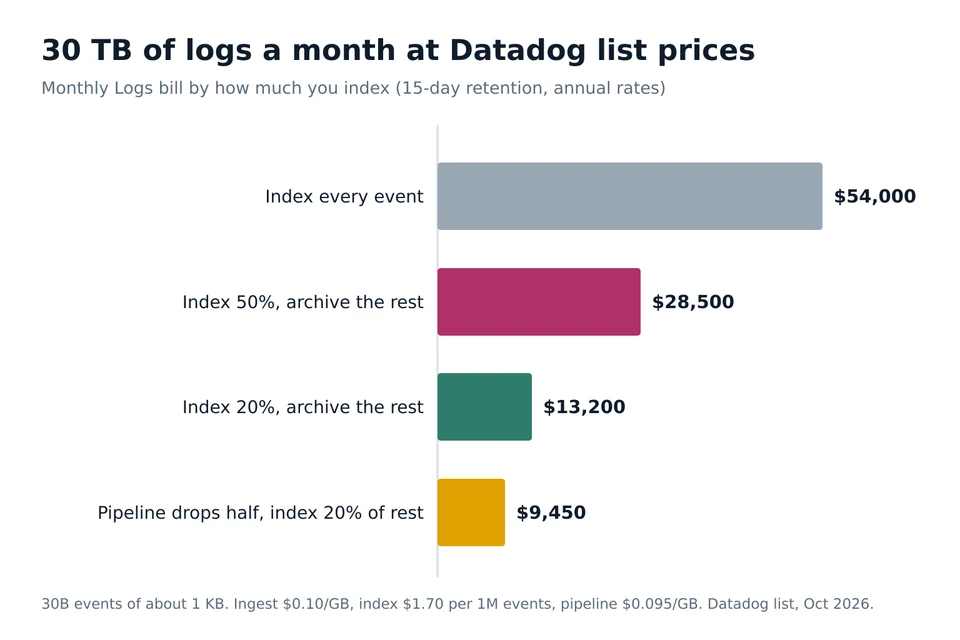
This is the single most useful number on Datadog's rate card. Ingesting a gigabyte of logs costs $0.10. Keeping the roughly one million events in that gigabyte in a 15-day index costs about $1.70, so indexing is around 17 times the price of ingestion. Exclusion filters, which stop logs from being indexed while they still flow through Live Tail, metrics and archives, attack the expensive half and cost nothing. Flex Logs stores events at $0.05 per million a month for long retention, though Flex compute is quoted by sales. Archives to S3, Google Cloud Storage or Azure are included in the ingest price, and rehydrating them later costs $0.10 per compressed GB scanned. A pipeline adds the second cut: data dropped before ingest never pays the $0.10 either. On a 30 TB month, indexing 20 percent instead of everything takes the Logs bill from $54,000 to $13,200 at list price before any tool is bought.
Custom metrics: cardinality, not data points
A custom metric in Datadog is a unique combination of a metric name and its tag values, including the host tag. Sending a data point every second costs the same as every minute; adding a tag with a thousand values multiplies the count by a thousand. That is why custom metric overage tends to arrive as a step change after a deploy. Metrics without Limits lets you choose which tags stay queryable, so the unqueried combinations stop counting as indexed metrics and are billed only as ingested metrics at $0.10 per 100 rather than $5. Log-based metrics count toward the custom metric allotment too. A tool helps here only if it shows the new series by team before the month closes; a pipeline helps if it can strip high-cardinality tags such as user or request IDs before submission.
How each tool charges, and whether the fee eats the saving
Pipelines charge per gigabyte or by daily volume: Datadog Observability Pipelines $0.095 per GB on an annual plan, Cribl.Cloud about $0.32 per GB on cloud workers after a free tier up to 1 TB a day, Grepr $0.20 per GB of logs, Edge Delta $3,650 a year for 100 GB a day on AWS Marketplace, and Sawmills from $2,500 a month on an annual commitment. A pipeline that charges per GB processed earns its fee only if it removes more than its price in Datadog charges, which is easy on logs and harder on metrics. Attribution tools charge by tracked spend: Vantage $200 a month plus 1 percent above $20,000 on its Enterprise listing, CloudZero $19 per $1,000 of AWS spend a month, Finout $12,000 or $40,000 a year by AWS spend tier. Datadog's own committed rates are 15 to 33 percent below on-demand, so committing to the steady base is a saving no tool provides.
At a glance
12 Datadog cost optimization tools compared
← Scroll to see all columns →
| Tool | Best for | Reduces or attributes | The Datadog catch | Pricing |
|---|---|---|---|---|
| Datadog native controls (Metrics without Limits, exclusion filters, Flex Logs, Datadog Costs view) | Every Datadog customer, as the free baseline | Reduces: index and metric volume you choose to drop; attributes by product and up to three tag keys | Ingestion is still billed on every log you send; Flex compute is quoted by sales | Datadog Costs view free; ingested custom metrics $0.10 per 100; Flex storage $0.05 per 1M events |
| Datadog Observability Pipelines | Datadog-only shops that want pre-ingest filtering without another vendor | Reduces: filter, sample, quota, dedupe and reduce before data reaches Datadog | Billed per GB that enters the pipeline, so it pays only when it drops enough | $0.095 per GB on an annual plan, $0.12 on demand; Plus tier $1,950 per vCPU a month |
| Cribl Stream | Large log estates sending to several destinations, not only Datadog | Reduces: routes, filters, samples and reshapes telemetry before any destination | A full product to operate; value grows with the number of destinations | Free up to 1 TB a day; Cribl.Cloud about $0.32 per GB on cloud workers, $0.26 on hybrid |
| Grepr | Teams whose Datadog log bill is mostly repetitive noise | Reduces: summarizes repetitive logs, keeps raw data in a data lake, backfills on incidents | Metrics support was still announced as coming in 2026; logs and traces only | Free up to 4 TB of logs a month; Pro $0.20 per GB of logs, $0.15 per GB of traces |
| Edge Delta | Teams that want a pipeline with published annual prices by daily volume | Reduces: filters, transforms and optimizes telemetry at the edge before Datadog | Repositioned toward AI SRE agents; check that the pipeline stays the product you buy | AWS Marketplace: $3,650 a year for 100 GB a day, $109,500 a year for 1 TB a day |
| Sawmills | Mid-size teams that want a managed OpenTelemetry pipeline with a fixed annual price | Reduces: OpenTelemetry-based filtering and agent-driven telemetry management | Entry price is high for small estates; savings figures are vendor claims | From $2,500 a month on an annual commitment, priced by ingest volume |
| Chronosphere Telemetry Pipeline (Palo Alto Networks) | Palo Alto Networks customers and large Fluent Bit estates | Reduces: Fluent Bit based log pipeline that filters before Datadog | Now part of Palo Alto Networks; pipeline pricing is quote only | Quote; the full Chronosphere platform lists $180,000 a year on AWS Marketplace |
| Mezmo | Teams already on Mezmo pipelines | Reduces: telemetry pipeline with a Datadog log and metric profiling workflow | Repositioned around an open-source SRE agent; no published price | Quote, priced by data volume and retention |
| Vantage | Teams that want Datadog cost next to cloud cost at a published price | Attributes: Datadog usage and cost by service, team and cloud resource, with budgets and alerts | Changes nothing in Datadog; pricing tiers count Datadog spend as tracked spend | Free to $2,500 tracked; Pro $30 and Business $200 a month; Enterprise $200 plus 1% above $20,000 |
| Finout | Enterprises that want Datadog waste recommendations inside a FinOps platform | Attributes and recommends: Datadog cost for 38 products, CostGuard waste findings | Marketplace tiers are set by AWS spend, not Datadog spend | AWS Marketplace: $12,000 a year up to $500,000 AWS spend, $40,000 up to $2M |
| CloudZero | SaaS companies that want Datadog cost per customer or feature | Attributes: every Datadog charge to the team, product or customer behind it | No volume reduction; price scales with AWS spend | AWS Marketplace: $19 per $1,000 of monthly AWS spend a month, or $209 per unit a year |
| CostAnalyst | Finance and FinOps leads who want Datadog beside cloud and SaaS spend by team, at a flat price | Attributes: Datadog charges from the cost file you upload, by product and team, with jump alerts | Does not reduce volume or connect to Datadog; reads the files you upload | From $59 a month on yearly billing |
Vendors change pricing and packaging often, so confirm the current figure before you buy.
Tool by tool
What each tool is genuinely best at
Datadog native controls (Metrics without Limits, exclusion filters, Flex Logs, Datadog Costs view)
Best for: Every Datadog customer, as the free baseline
Datadog gives you more control than most teams use. Metrics without Limits keeps only the tag keys you query, index exclusion filters and daily quotas stop logs from being indexed, Flex Logs moves long retention to a cheaper tier, and archives to object storage are included in the ingest price. The Datadog Costs view in Cloud Cost Management shows daily cost by product, organization and up to three Usage Attribution tags with about a 48 hour delay, at no additional charge for customers billed directly by Datadog. What none of it does is cut ingestion, because every log sent is billed at $0.10 per GB whether it is indexed or not.
Datadog Observability Pipelines
Best for: Datadog-only shops that want pre-ingest filtering without another vendor
Datadog's own pipeline runs a worker inside your infrastructure and applies processors such as filter, sample, quota, deduplicate, reduce, throttle, generate metrics and tag cardinality control before the data is ingested. Because the worker is Datadog's, setup and support stay in one contract, and the routing options include sending low-value logs straight to archive storage. The arithmetic is simple: at $0.095 per GB processed, it pays for itself if it keeps out of Datadog more than about a tenth of what passes through it once indexing is counted. It does not help with host counts or APM.
Cribl Stream
Best for: Large log estates sending to several destinations, not only Datadog
Cribl Stream is the most established vendor-neutral telemetry pipeline. Its free plan covers up to 1 TB a day, which is generous for a team testing log reduction, and paid plans burn credits at $1 each: 0.32 credits per GB on Cribl.Cloud workers and 0.26 on hybrid workers. Its Cribl Cloud listing on AWS Marketplace is private offer only. Cribl suits teams that split data between Datadog, a SIEM and cheap object storage, because one pipeline feeds all of them. For a Datadog-only estate it is more product than the problem needs.
Grepr
Best for: Teams whose Datadog log bill is mostly repetitive noise
Grepr sits in front of Datadog and collapses repeated log patterns into summaries in short windows, while the full raw data lands in an S3 data lake that it can push back into Datadog when an incident needs it. The pricing page is unusually clear: free up to 4 TB of logs and 8 TB of traces a month, then $0.20 per GB of logs and $0.15 per GB of traces. Its headline claims of up to 90 percent noise reduction are the vendor's own figures. It fits a noisy, high-volume log estate better than a metrics problem.
Edge Delta
Best for: Teams that want a pipeline with published annual prices by daily volume
Edge Delta processes telemetry close to where it is produced and sends a reduced stream to Datadog. Its own pricing page shows a free Hobby plan and a $20 a month Pro plan with credits, and its AWS Marketplace listing prices 12-month contracts by daily volume: $3,650 for 100 GB a day, $54,750 for 500 GB a day and $109,500 for 1 TB a day, which works out to $0.10 to $0.30 per GB. The listing has no refunds. The company now markets itself as an AI SRE platform, so confirm the pipeline scope in the order form.
Sawmills
Best for: Mid-size teams that want a managed OpenTelemetry pipeline with a fixed annual price
Sawmills is built on OpenTelemetry and sells a managed pipeline that recommends and applies reductions across logs and metrics, with an agentic layer added in March 2026. Plans start at $2,500 a month on an annual commitment and scale with ingest volume. The vendor states typical savings of 50 to 80 percent. At $30,000 a year minimum it fits a Datadog bill in the low six figures or above, where a 30 percent cut pays for it several times over.
Chronosphere Telemetry Pipeline (Palo Alto Networks)
Best for: Palo Alto Networks customers and large Fluent Bit estates
Palo Alto Networks completed its acquisition of Chronosphere on 29 January 2026, and the platform now carries the Cortex XCOR name. The Telemetry Pipeline, built by the team behind Fluent Bit, is still sold on its own and claims to reduce log data costs by at least 30 percent. Its AWS Marketplace prices are inconsistent placeholders, so treat it as quote only. The full Chronosphere platform, listed at $180,000 a year, is a Datadog replacement rather than a Datadog cost tool.
Mezmo
Best for: Teams already on Mezmo pipelines
Mezmo, formerly LogDNA, offered one of the first Datadog-specific cost workflows, profiling logs, metrics and tags to estimate what each source adds to the bill before filtering it. The company now leads with an open-source SRE agent, and the pipeline sits under it. It publishes no price and has no AWS Marketplace listing we could find, so a buyer starts with a sales call.
Vantage
Best for: Teams that want Datadog cost next to cloud cost at a published price
Vantage pulls Datadog usage through the Usage Metering API with a read-only OAuth token, maps host cost to the cloud resources underneath, and puts Datadog in the same reports, budgets and anomaly alerts as AWS, Azure and Google Cloud. Its prices are public: free up to $2,500 of tracked spend, $30 a month to $7,500, $200 to $20,000, and on its AWS Marketplace Enterprise listing $200 a month plus 1 percent of tracked spend above $20,000. Tracking a $1 million a year Datadog bill alone would come to about $830 a month on that listing.
Vantage compared to CostAnalystFinout
Best for: Enterprises that want Datadog waste recommendations inside a FinOps platform
Finout's Datadog integration uses Usage Attribution tags to break cost down across 38 Datadog products, and its CostGuard module flags waste such as idle synthetic tests and unused log and metric volume. Its pricing page shows no numbers, but its AWS Marketplace listing does: $12,000 for 12 months up to $500,000 of annual AWS spend and $40,000 up to $2 million. It recommends; the change itself is still yours to make in Datadog.
See what Finout costsCloudZero
Best for: SaaS companies that want Datadog cost per customer or feature
CloudZero folds Datadog into its unit economics model, so a SaaS company can see observability cost per customer, feature or query next to cloud cost, with anomaly alerts routed to the owning engineers. The site quotes on request, while the AWS Marketplace listing sells it in units of $1,000 of monthly AWS spend at $19 a month or $209 for 12 months. It is strongest when the question is margin per customer, not how to shrink the log bill.
See what CloudZero costsCostAnalyst
Best for: Finance and FinOps leads who want Datadog beside cloud and SaaS spend by team, at a flat price
CostAnalyst reads the billing files you upload: AWS, Azure or Google Cloud exports, plus a CSV of Datadog charges with a date, a product and a cost per row, and the SaaS subscriptions you list. It shows Datadog by product and team next to everything else you pay for, flags a month-over-month jump as soon as the file lands, and sends each team its share by email. It does not touch your telemetry or your Datadog account. Choose it when the question is who owns the bill and what changed, and pair it with a pipeline when the answer is logs.
See how CostAnalyst worksHow to choose
Pick by the problem you actually have
Your Datadog bill is under $100,000 a year
Use the native controls first. Turn on the Datadog Costs view, add index exclusion filters for debug and health-check logs, apply Metrics without Limits to your largest custom metrics, and commit to your steady host count at the annual rate. A paid tool rarely earns its fee at this size.
Logs are the largest line
Index less before you buy anything, then add a pipeline. Datadog Observability Pipelines keeps everything in one contract at $0.095 per GB; Grepr fits noisy, repetitive logs at $0.20 per GB with a free tier; Cribl Stream fits when the same logs also feed a SIEM or object storage.
Custom metrics jumped after a deploy
Find the new high-cardinality tag in the Datadog Costs view or Usage Attribution, then drop it with Metrics without Limits or a pipeline cardinality control. Attribution tools help only if they surface the change before the month closes.
Nobody knows which team owns the Datadog bill
Buy attribution, not reduction. Vantage is the cheapest published option, CloudZero suits per-customer unit cost, Finout adds waste recommendations, and CostAnalyst puts Datadog next to cloud and SaaS spend by team from $59 a month.
You are at $500,000 a year or more
Run a pipeline and a commitment review together. Sawmills, Edge Delta or Cribl cut volume, and the annual commit should cover only the steady base, because on-demand rates run 15 to 50 percent above committed ones depending on the product.
You are considering leaving Datadog
Price the replacement against a reduced Datadog bill, not the current one. A pipeline in front of Datadog keeps the option open, because the same pipeline can route to a new backend later.
Questions buyers ask
Datadog cost optimization tools, answered
How can I reduce my Datadog costs?
Reduce Datadog costs by attacking the meter that is growing. For logs, index less with exclusion filters and send the rest to archives, which are included in the ingest price. For custom metrics, use Metrics without Limits to drop unqueried tags. For hosts, commit to the steady base at the annual rate, $15 instead of $18 per Pro host. A telemetry pipeline cuts volume further before ingestion.
What is the best tool to reduce Datadog costs?
For logs, a telemetry pipeline is the best tool to reduce Datadog costs: Datadog Observability Pipelines at $0.095 per GB if you want one vendor, Grepr at $0.20 per GB for noisy logs, Cribl Stream if logs also go elsewhere. For knowing who caused the bill, Vantage, Finout, CloudZero or CostAnalyst attribute Datadog spend to teams. Native controls come first because they are free.
Why is Datadog so expensive?
Datadog gets expensive because each product is metered separately and volume grows quietly. Indexing logs costs about 17 times what ingesting them does, custom metrics are counted per unique tag combination at $5 per 100 over the allotment, and on-demand rates run 20 percent or more above annual ones. Most large bills are default settings nobody revisited.
How much does Datadog cost per host?
Datadog Infrastructure Pro costs $15 per host per month on an annual plan and $18 on demand; Enterprise is $23 and $27. APM adds $31 per APM host annually or $36 on demand. Hosts are billed at the high-water mark of the lower 99 percent of hourly counts, so the busiest 1 percent of hours in the month is ignored.
What is the Datadog cost per custom metric?
Datadog includes 100 custom metrics per host on Infrastructure Pro and 200 on Enterprise, averaged across the account. Above that, list price is $5 per 100 custom metrics a month, or 5 cents each. With Metrics without Limits, ingested but unindexed metrics cost $0.10 per 100. A custom metric is each unique combination of name and tag values.
Does Datadog charge for log ingestion and indexing separately?
Yes. Datadog charges $0.10 per GB to ingest logs and then $1.06 to $2.50 per million events to index them for 3 to 30 days on an annual plan, $1.70 for the common 15-day retention. Excluded logs still pay ingestion. Archiving to S3, Google Cloud Storage or Azure is included, and rehydration costs $0.10 per compressed GB scanned.
Is the Datadog Costs view in Cloud Cost Management free?
Yes. Datadog states there is no additional charge for the Datadog Costs view, which shows daily Datadog spend by product, organization and up to three Usage Attribution tag keys, with about a 48 hour delay and 15 months of history. It is available to customers billed directly by Datadog. Cloud Cost Management for AWS, Azure and GCP costs $5 per $1,000 of spend a month.
Is Datadog Observability Pipelines cheaper than Cribl?
On list price, Datadog Observability Pipelines costs $0.095 per GB on an annual plan, while Cribl.Cloud burns about $0.32 per GB on cloud workers. Cribl is free up to 1 TB a day, which makes it cheaper for small estates and pilots. Above that, Datadog's pipeline is cheaper per GB, and Cribl earns its price when it routes to several destinations.
Do Datadog cost tools change my Datadog configuration?
Attribution tools such as Vantage, Finout, CloudZero and CostAnalyst do not; they read usage or billing data and report it. Pipelines such as Cribl, Grepr, Edge Delta and Sawmills change what reaches Datadog by dropping or summarizing data before ingestion. Native controls such as exclusion filters and Metrics without Limits are changes you make in Datadog yourself.
Who owns Chronosphere now?
Palo Alto Networks owns Chronosphere. It announced the acquisition in November 2025 at $3.35 billion and closed it on 29 January 2026, and the platform now carries the Cortex XCOR name. The Chronosphere Telemetry Pipeline is still sold separately as a log reduction tool in front of backends such as Datadog.
Keep reading
See your savings in dollars
Upload your cloud billing export and get a prioritized savings plan. Money never moves. Create your account and get started.