RDS Extended Support Pricing and What MySQL 8.0 and PostgreSQL Cost After End of Support
By the CostAnalyst team
projected this month if unattended
Spend by team
Budget forecast
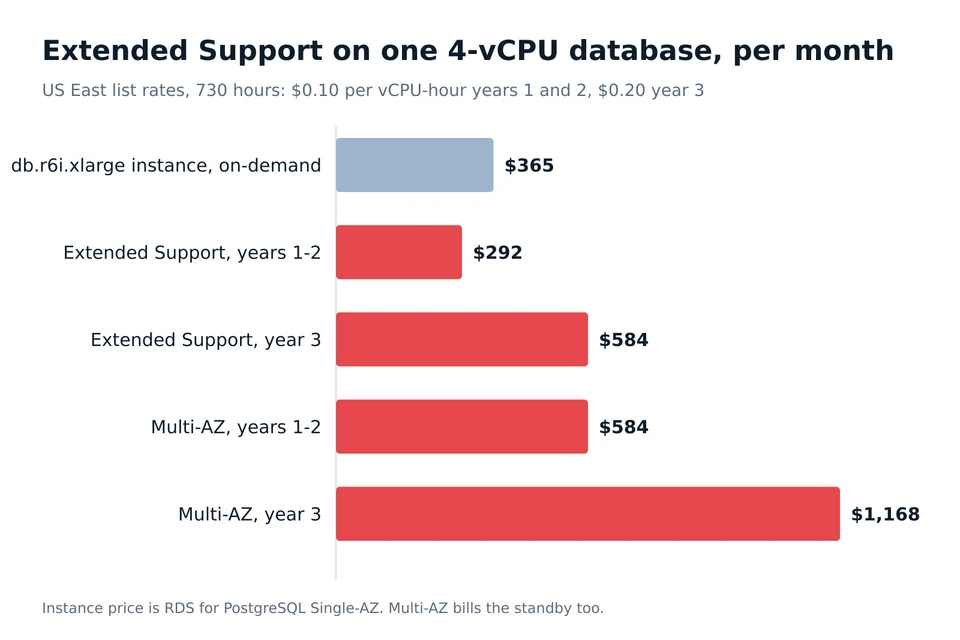
RDS Extended Support costs $0.10 per vCPU-hour in years one and two after a major version leaves standard support, and $0.20 per vCPU-hour in year three, at US East list prices. It is billed on top of the normal instance price, Multi-AZ standbys pay it too, and Reserved Instances do not reduce it. A 4-vCPU database pays about $292 a month extra in years one and two and $584 in year three, or double that on Multi-AZ.
MySQL 8.0 left standard support on 31 July 2026, so every RDS for MySQL 8.0 database still running in August picked up the charge automatically. PostgreSQL 13 started paying on 1 March 2026, and PostgreSQL 11 and MySQL 5.7 are already on the doubled year-three rate. Below are the current rates, which versions are paying them and when the price steps up, what the surcharge comes to per instance and per fleet, and how to find it on your bill before the next invoice.
RDS Extended Support pricing per vCPU-hour in 2026
These are AWS list prices for US East (N. Virginia), read from the AWS Price List and the RDS pricing pages in October 2026. Other regions are priced separately and are usually a little higher.
| What is billed | Years 1 and 2 | Year 3 | Unit |
|---|---|---|---|
| RDS for MySQL and RDS for PostgreSQL, provisioned instances | $0.10 | $0.20 | per vCPU-hour |
| Aurora MySQL and Aurora PostgreSQL, provisioned instances | $0.10 | $0.20 | per vCPU-hour |
| Aurora Serverless v2 | $0.085 | $0.170 | per ACU-hour |
| Multi-AZ deployments | The standby is billed as well, so the charge doubles | per instance | |
Three rules decide the size of the bill. The charge is per vCPU of the instance class, not per database or per connection, so a db.r6i.4xlarge pays four times what a db.r6i.xlarge pays. It starts the day after the end of standard support with no opt-in, because AWS enrolls every database automatically. And it stops only when you upgrade to a version under standard support or delete the database; it comes back if the version you upgraded to later leaves standard support too.
Which RDS versions are paying Extended Support now
The dates below come from the AWS release calendars for RDS for MySQL and RDS for PostgreSQL. The year-three column is when the rate doubles.
| Engine version | Paying since | Year 3 rate from | Extended Support ends |
|---|---|---|---|
| RDS for MySQL 5.7 | 1 March 2024 | 1 March 2026 (now) | 30 June 2029 |
| RDS for MySQL 8.0 | 1 August 2026 | 1 August 2028 | 31 July 2029 |
| RDS for PostgreSQL 11 | 1 April 2024 | 1 April 2026 (now) | 31 March 2027 |
| RDS for PostgreSQL 12 | 1 March 2025 | 1 March 2027 | 29 February 2028 |
| RDS for PostgreSQL 13 | 1 March 2026 | 1 March 2028 | 28 February 2029 |
| RDS for PostgreSQL 14 | Starts 1 March 2027 | 1 March 2029 | 28 February 2030 |
Two of these deserve attention this quarter. MySQL 8.0 is the largest installed base on RDS, and its first Extended Support invoice arrived in September for August usage, often as a surprise because nothing changed in the console. In June 2026 AWS also pushed the end of Extended Support for MySQL 5.7 and Aurora MySQL version 2 out to 30 June 2029 with no price increase, which means those databases can now sit on the $0.20 year-three rate for more than three more years if nobody acts. PostgreSQL 14 is the next version to start paying, on 1 March 2027.
What RDS Extended Support costs per instance
A month here is 730 hours, so each vCPU adds $73 a month in years one and two and $146 a month in year three. For common instance classes on Single-AZ:
| Instance class | vCPUs | Years 1 and 2, per month | Year 3, per month | Year 3 on Multi-AZ, per month |
|---|---|---|---|---|
| db.t3.medium or db.m6i.large | 2 | $146 | $292 | $584 |
| db.r6i.xlarge or db.r5.xlarge | 4 | $292 | $584 | $1,168 |
| db.r6i.2xlarge or db.m6g.2xlarge | 8 | $584 | $1,168 | $2,336 |
| db.r6i.4xlarge | 16 | $1,168 | $2,336 | $4,672 |
| db.r6i.8xlarge | 32 | $2,336 | $4,672 | $9,344 |
The comparison with the instance price is the part that gets attention in budget reviews. A db.r6i.xlarge running PostgreSQL costs about $365 a month on demand in US East. In years one and two, Extended Support adds 80 percent of that. In year three it adds 160 percent, and on Multi-AZ the surcharge alone is larger than the price of both instances.
For a fleet the numbers add up fast. Take 40 MySQL 8.0 databases averaging 4 vCPUs, half of them Multi-AZ. That is 240 billed vCPUs, so about $17,500 a month, or $210,000 a year, from August 2026, rising to about $35,000 a month in August 2028 if nothing is upgraded. Most teams find that the cost of a planned upgrade project is a fraction of one year of that.
Do Reserved Instances or Savings Plans reduce Extended Support?
No for Reserved Instances. AWS applies the Extended Support charge the same way to On-Demand and Reserved Instance databases, as a separate line on top of the instance cost, so a fully reserved fleet still pays the full per-vCPU rate. We found no AWS statement that Database Savings Plans, launched in December 2025, discount the Extended Support line either, so budget it at list. One more trap: if you downsize a database to cut the surcharge, the Reserved Instance you bought for the larger class keeps billing until it expires or another database in the family uses it.
Is RDS Extended Support worth paying?
Sometimes, for a defined period. It buys time when a major version upgrade needs application changes you cannot make before the deadline, such as a MySQL 8.0 to 8.4 move for an application that still relies on mysql_native_password, which 8.4 disables by default, or a PostgreSQL upgrade blocked by an extension. You also get security patches AWS keeps releasing for these versions. It is a poor deal as a default. At the year-three rate a 4-vCPU Multi-AZ database pays about $14,000 a year for the privilege of not upgrading, and the charge never turns into anything you keep.
A workable rule: pay Extended Support only for databases with a dated upgrade plan, rank the rest by surcharge per month, and start the upgrades from the top. A database in its first year with a change freeze is a reasonable payer. A database in year three nobody owns is not.
How to find RDS Extended Support charges on your AWS bill
The charge shows up as its own line item in the Cost and Usage Report and in Cost Explorer under Amazon Relational Database Service, separate from instance hours, so you can filter for it rather than estimate it. To find the databases behind it, list your DB instances with their engine version and compare against the calendar above, or read the EngineLifecycleSupport setting each instance carries. If your CUR already lands in Athena, an AI data analyst that turns plain-English questions into SQL can pull the Extended Support line by account and team without anyone writing the query by hand.
Two settings stop new charges at the source. When you create or restore a database you can pass open-source-rds-extended-support-disabled for the engine lifecycle support option, so it cannot land on an expired version by accident. And you can change that setting on an existing database at any time; AWS documents that disabling it on a database already past its end of standard support upgrades it automatically to the next supported major version, which is an upgrade you should test first, not a billing switch.
Which tools flag Extended Support before the invoice does
AWS Compute Optimizer marks databases with a newer engine version available, and Datadog Cloud Cost Management recommends migrating engines that pay Extended Support. Vantage sends notices for databases approaching the end of standard support. Our comparison of RDS rightsizing tools covers what each of these costs and whether it changes anything for you, and AWS Compute Optimizer pricing explains its paid metrics if you want the 93-day lookback.
CostAnalyst works from the bill rather than the database. You upload your AWS billing export and it shows RDS spend by account, team, engine and instance family, puts the Extended Support charges on their own line, flags the month they appear or double, and emails an alert when RDS spend jumps. After an upgrade, the next export shows whether the surcharge actually stopped. Plans start at $59 a month billed annually and are listed on the pricing page, or you can run one AWS export through the analysis first.
Frequently asked questions
How much does RDS Extended Support cost?
In US East it costs $0.10 per vCPU-hour in years one and two after the end of standard support and $0.20 per vCPU-hour in year three, on top of the instance price. Aurora Serverless v2 pays $0.085 and $0.170 per ACU-hour. A 4-vCPU instance pays about $292 a month in years one and two and $584 in year three.
Does Multi-AZ double the Extended Support charge?
Yes. AWS bills Extended Support on the standby instance of a Multi-AZ deployment as well as the primary, so the charge is twice the Single-AZ figure. A 4-vCPU Multi-AZ database on the year-three rate pays about $1,168 a month in Extended Support alone, more than the two instances cost together.
When did RDS for MySQL 8.0 Extended Support charges start?
On 1 August 2026, the day after MySQL 8.0 reached the end of RDS standard support on 31 July 2026. The year-one and year-two rate of $0.10 per vCPU-hour applies until 31 July 2028, the $0.20 year-three rate starts on 1 August 2028, and Extended Support for 8.0 ends on 31 July 2029.
Do Reserved Instances cover RDS Extended Support?
No. The Extended Support charge is billed separately from instance hours and applies the same way to On-Demand and Reserved Instance databases, so reservations do not reduce it. The only ways to stop it are upgrading to a major version under standard support or deleting the database.
How do I avoid RDS Extended Support charges?
Upgrade each database to a major version under standard support before its end date, such as MySQL 8.4 or PostgreSQL 16 or later. For new databases, set the engine lifecycle support option to open-source-rds-extended-support-disabled when you create or restore them. Turning that option off on an existing expired database triggers an automatic major version upgrade.
What happens when RDS Extended Support ends?
AWS upgrades the database to a supported major version automatically after the end of Extended Support date, for example after 31 July 2029 for MySQL 8.0. That forced upgrade can break applications that were never tested on the newer version, so plan the upgrade yourself well before the date.
See where your cloud and SaaS money is leaking
Upload your cloud billing export and see your savings in dollars. Transparent pricing, no card to start.