Harness Cloud Cost Management Alternatives and Harness CCM Competitors Compared on Price
Harness Cloud Cost Management, renamed Cloud & AI Cost Management (CACM) in Harness documentation, is a good product with a pricing problem: outside the free tier there is no number anywhere. Harness now sells it as four separate modules, Cloud Cost Insights, Commitment Orchestrator, AutoStopping and Cluster Orchestrator, each quoted by sales and licensed against the cloud spend Harness manages. Teams look for a Harness CCM alternative for concrete reasons. The Free Forever plan stops at $250,000 of cloud spend and keeps only 30 days of data. The renewal quote arrives as a share of a growing cloud bill. Or the company uses Harness for CI/CD and wants a cost tool finance can own without a Harness seat. This page compares ten options by which Harness module they actually replace and what each vendor publishes as a price, on its own site or on AWS Marketplace.
projected this month if unattended
Spend by team
Budget forecast
The short answer
The best Harness Cloud Cost Management alternative depends on which module you rely on. For cost visibility and allocation, CloudZero ($19 per $1,000 of monthly AWS spend on AWS Marketplace) and Finout ($12,000 a year up to $500,000 of AWS spend) publish prices Harness does not. For AutoStopping and spot automation on Kubernetes, CAST AI ($1,000 a month plus $5 per CPU) replaces Cluster Orchestrator. Small teams can start on Vantage at $30 or $200 a month.
CostAnalyst is on this list, so the plain version first. We cover only part of what Harness CCM does: we read the AWS, Azure and Google Cloud billing exports you upload and the SaaS subscriptions you list, report savings in dollars, send anomaly alerts by email and allocate spend by account and owner. We do not stop idle resources, buy commitments or manage Kubernetes nodes. Everything below about other tools comes from their own websites, documentation or AWS Marketplace listings read on 1 October 2026, and anything from a third party is labeled as such.
How we compared
Five things that actually separate these tools
Which Harness module you would actually miss
Harness splits cloud cost management into four modules, and the alternatives line up against them very differently. Cloud Cost Insights is the reporting layer, with Perspectives, Cost Categories, BI dashboards, budgets, anomalies, recommendations and asset governance; every FinOps platform on this page replaces it. Commitment Orchestrator buys and manages Reserved Instances and Savings Plans for EC2 and RDS; that job moves to a commitment manager such as ProsperOps, nOps or Spot Eco, not to a reporting tool. AutoStopping shuts idle non-production resources and is the hardest piece to replace one for one. Cluster Orchestrator does Karpenter-based autoscaling, bin packing and spot distribution on EKS, which CAST AI and Spot Ocean also do. Before you shortlist anything, look at the subscription page in Harness (Account Settings, Subscriptions) and note which of the four SKUs you pay for and which ones you use. Most teams that leave Harness CCM use Cost Insights heavily and one automation module lightly.
What Harness CCM costs you today, and how the license is measured
Harness documentation describes two tiers. Free Forever covers cloud spend of up to $250,000 a year in its feature table, two Kubernetes clusters, ten AutoStopping rules and 30 days of visible data, with no currency preferences. The same page also says "USD250K/month" in two sentences, so confirm which one applies to you in writing. Enterprise has no published price on harness.io, which sends Cloud & AI Cost Management to contact sales, and third-party write-ups describe it as a percentage of cloud spend without a confirmed rate. The unit is documented, though: usage counts against Total Cloud Spend Managed, defined as total unblended spend minus EDP discounts minus Marketplace spend. That definition is useful when you compare quotes, because CloudZero and Finout meter AWS spend in their own ways and a vendor that counts gross spend will look more expensive than it is. Also note what happens on expiry: data collection, new recommendations, budget alerts and anomaly alerts all stop, while historical data stays readable.
How the alternatives charge, and why the unit decides the ranking
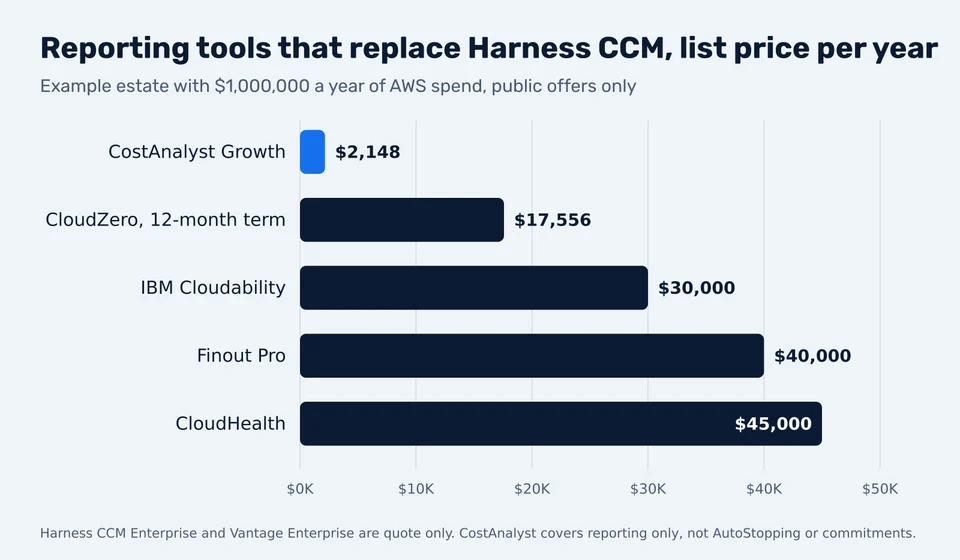
Published prices in this category use four different units. CloudZero sells units of $1,000 of monthly AWS spend at $19 a month or $209 a year each on AWS Marketplace, about 1.74 to 1.90 percent of the AWS bill. Finout uses flat bands: Business at $12,000 a year up to $500,000 of annual AWS spend, Pro at $40,000 up to $2 million. CloudHealth and Cloudability sell tiers on AWS Marketplace, $45,000 a year up to $150,000 of monthly AWS spend for CloudHealth and $30,000 a year up to $1 million of annual cloud spend for Cloudability. CAST AI charges per managed CPU, $5 per CPU per month plus a $1,000 monthly plan fee. At $1 million of annual AWS spend, the public offers come to roughly $17,600 for CloudZero, $40,000 for Finout Pro, $30,000 for Cloudability and $45,000 for CloudHealth. Put Harness's quote on the same line, converted to an annual figure at your current spend and at next year's forecast, since a percentage contract grows with the bill.
What you lose when you move, and how long the migration takes
Three things do not travel. Perspectives and Cost Categories are Harness objects; rebuild them as the new vendor's views and allocation rules, and export the definitions first because they encode months of tagging decisions. AutoStopping rules sit on top of a Harness proxy or load balancer and a connector with write permissions; when you switch them off, idle environments start billing again the same day unless something else stops them. And history: on Free Forever you can only see 30 days, so take a CSV export of at least twelve months of cost by team before the license ends, if you are on Enterprise, or start the new tool in parallel for a month if you are not. A reporting-only migration usually takes two to four weeks of part-time work. A migration that also replaces AutoStopping or Cluster Orchestrator needs a test cluster and a rollback plan.
How you will prove the switch saved money
Every vendor here will show you a savings figure, and some bill on it. Freeze a baseline before the trial: the last full month of spend per account and team, the Harness subscription line itself, and any savings Harness AutoStopping reported, so you know what you are giving up. After the switch, compare invoices rather than dashboards, and check that idle non-production spend did not creep back once AutoStopping was gone. If the new contract is a savings share, get the baseline definition in writing. CostAnalyst does this before-and-after read per account and owner from the billing exports you upload, and the same report is what finance will ask for at the next renewal.
At a glance
10 Harness Cloud Cost Management alternatives compared
← Scroll to see all columns →
| Tool | Best for | Which Harness module it replaces | The catch | Published pricing |
|---|---|---|---|---|
| Harness Free Forever | Staying on Harness while spend is small | Nothing; it is the free tier of the same product | 30 days of data, 2 clusters, 10 AutoStopping rules; $250K spend ceiling | Free up to $250,000 of cloud spend a year per the plan table |
| CloudZero | Unit cost and cost per customer on AWS-heavy SaaS | Cloud Cost Insights (reporting, allocation, anomalies) | Price unit is AWS spend only; no refunds on the Marketplace listing | $19 a month or $209 a year per $1,000 of monthly AWS spend (AWS Marketplace) |
| Finout | Multi-source showback with a flat, predictable fee | Cloud Cost Insights, including virtual tagging | Kubernetes adds 25% on Business and Pro; SAML only on Enterprise | Business $12,000 a year to $500K AWS spend; Pro $40,000 to $2M (AWS Marketplace) |
| Vantage | Small teams that outgrew the Harness free tier | Cloud Cost Insights for smaller bills | Self-serve tiers top out at $20,000 of monthly cloud spend | Starter free to $2,500 spend; Pro $30 a month to $7,500; Business $200 a month to $20,000 |
| IBM Cloudability | Enterprises standardizing on IBM Apptio | Cloud Cost Insights with enterprise chargeback | Being folded into the Apptio stack; tiers are annual spend bands | $30,000 a year to $1M annual cloud spend; $76,680 to $3M (AWS Marketplace) |
| VMware Tanzu CloudHealth | Large multi-cloud estates with policy governance needs | Cloud Cost Insights and asset governance policies | Tiers are monthly AWS spend; one listing is reseller-only | $45,000 a year to $150K monthly AWS spend; $90,000 to $300K (AWS Marketplace) |
| CAST AI | Replacing Cluster Orchestrator and Kubernetes AutoStopping | Cluster Orchestrator (node autoscaling, spot, bin packing) and pod rightsizing | Takes write access to your node layer; no refunds on Marketplace | Free monitoring; Growth $1,000 a month plus $5 per CPU (AWS Marketplace) |
| Spot by Flexera (Ocean and Eco) | Replacing Cluster Orchestrator and Commitment Orchestrator together | Cluster Orchestrator (Ocean) and Commitment Orchestrator (Eco) | Two pricing dimensions on one listing; ask which applies | 28% of savings, or $1.415 per 100 vCPU-hours, on a 12-month AWS Marketplace contract |
| ProsperOps | Replacing Commitment Orchestrator only | Commitment Orchestrator (Savings Plans and Reserved Instances) | Savings share with no published rate | Share of savings; the AWS Marketplace meter shows no rate |
| CostAnalyst | Finance-owned reporting across cloud and SaaS at a published price | The reporting half of Cloud Cost Insights for cloud and SaaS spend | Does not stop resources, buy commitments or manage nodes | $59, $179 and $479 a month billed yearly, published |
Vendors change pricing and packaging often, so confirm the current figure before you buy.
Tool by tool
What each tool is genuinely best at
Harness Free Forever
Best for: Staying on Harness while spend is small
The cheapest alternative to a Harness Enterprise renewal is sometimes Harness itself on the free tier. Free Forever is a no-contract plan with the cost visibility features, two Kubernetes clusters and ten AutoStopping rules. The limits bite quickly: data is visible for only 30 days, so month-over-month and quarter-over-quarter reporting is out, currency preferences are unavailable, and above $250,000 of cloud spend Harness requires an Enterprise plan. The documentation states that ceiling as a year in its table and as a month in its text, so check which applies before planning around it. It fits a startup that mainly wants AutoStopping on a few dev environments.
Harness Free Forever compared to CostAnalystCloudZero
Best for: Unit cost and cost per customer on AWS-heavy SaaS
CloudZero is the strongest replacement for Harness Perspectives and Cost Categories if your question is what a customer, feature or product costs. It ingests AWS, Azure, Google Cloud and Kubernetes plus Snowflake, Databricks, Datadog and other sources, and allocates without perfect tagging. Its website asks for a quote, but its AWS Marketplace listing, sold by CloudZero, prices units of $1,000 of monthly AWS spend at $19 a month, $209 a year, $399 for 24 months or $608 for 36 months, with overage at $19 per extra unit. That is about $17,600 a year at $1 million of annual AWS spend. The listing says there are no refunds. It does not stop idle resources or buy commitments.
See what CloudZero costsFinout
Best for: Multi-source showback with a flat, predictable fee
Finout is the closest like-for-like for teams that used Harness mainly for reporting and allocation, and its flat bands are easier to budget than a percentage. It covers AWS, Azure, Google Cloud, Oracle Cloud, Kubernetes, Snowflake, Databricks, Datadog, OpenAI and Anthropic, with virtual tags that replace Harness Cost Categories. The AWS Marketplace public offer lists Business at $12,000 a year for up to $500,000 of annual AWS spend and Pro at $40,000 a year up to $2 million, with no discount for 24 or 36 months. Finout's own pricing page adds 25 percent for Kubernetes on Business and Pro, and an extra fee for cost per customer. No automation, so AutoStopping needs another answer.
See what Finout costsVantage
Best for: Small teams that outgrew the Harness free tier
Vantage publishes self-serve prices, which makes it the obvious landing spot for a team leaving Harness Free Forever without wanting a sales cycle. Starter is free up to $2,500 of cloud spend, Pro is $30 a month up to $7,500 and Business is $200 a month up to $20,000, with Enterprise quoted above that. It reports across the major clouds, Kubernetes and a long list of SaaS and data providers. Above $20,000 a month of spend you are back to a quote, so it suits smaller bills best.
Vantage compared to CostAnalystIBM Cloudability
Best for: Enterprises standardizing on IBM Apptio
Cloudability is the enterprise reporting and chargeback choice, particularly where IBM Apptio already runs IT financial management. Its AWS Marketplace tiers are public: $30,000 a year up to $1 million of annual cloud spend, $76,680 up to $3 million and $132,480 up to $6 million, which works out to between 2.2 and 3.0 percent of spend at the ceiling of each tier. It is heavier to roll out than Harness and does not stop resources. Since IBM bought Apptio in 2023, Cloudability has moved toward the wider Apptio suite, which helps if you want ITFM later and adds weight if you do not.
See what IBM Cloudability costsVMware Tanzu CloudHealth
Best for: Large multi-cloud estates with policy governance needs
CloudHealth, owned by Broadcom since the VMware acquisition and rebuilt in 2025, is the long-standing alternative for governance-heavy enterprises: perspectives, policies, rightsizing reports and reseller support across AWS, Azure and Google Cloud. Its AWS Marketplace ladder is $45,000 a year up to $150,000 of monthly AWS spend, $90,000 up to $300,000 and $150,000 up to $500,000, a flat 2.5 percent at each ceiling. At least one other listing is sold through a reseller with private pricing only, so check which listing a quote refers to. Like Cloudability, it reports and recommends rather than stopping resources.
See what VMware Tanzu CloudHealth costsCAST AI
Best for: Replacing Cluster Orchestrator and Kubernetes AutoStopping
If the Harness module you depend on is Cluster Orchestrator, CAST AI is the most complete replacement. It provisions nodes, mixes spot and on-demand with fallback, bin-packs, rebalances and rightsizes pods on EKS, GKE, AKS and Oracle Cloud, and it can hibernate clusters on a schedule, which covers part of what AutoStopping did for Kubernetes environments. Its AWS Marketplace listing has a free monitoring plan, Growth at $1,000 a month for up to 500 CPUs and Enterprise at $5,000 a month, each plus $5.00 per managed CPU per month. At 500 CPUs that is about $42,000 a year. It does not replace cost reporting for the non-Kubernetes estate.
See what CAST AI costsSpot by Flexera (Ocean and Eco)
Best for: Replacing Cluster Orchestrator and Commitment Orchestrator together
Flexera bought Spot from NetApp in 2025, and its two products map neatly onto two Harness modules: Ocean manages Kubernetes nodes, spot and headroom on EKS, ECS, AKS and GKE, and Eco manages Reserved Instance and Savings Plan portfolios. Flexera's own site shows no price, but the public Spot.io contract on AWS Marketplace lists a savings share of $0.28 per dollar saved on 12 months, $0.26 on 24 and $0.24 on 36, and a separate rate of $1.415 per 100 vCPU-hours. Reporting moves into Flexera One, which is a larger platform purchase than Harness CCM.
Spot by Flexera (Ocean and Eco) compared to CostAnalystProsperOps
Best for: Replacing Commitment Orchestrator only
ProsperOps does one thing, autonomous management of cloud commitments such as AWS Savings Plans and Reserved Instances, and it is the specialist answer if Commitment Orchestrator was the Harness module earning its keep. It charges a share of the savings it generates and publishes no percentage; its AWS Marketplace listing has a single savings-share meter at a placeholder rate. Public benchmarks from comparable vendors, such as Spot Eco at 28 percent and Zesty at 25 percent, give you a starting point for negotiation. It does no reporting beyond commitments, so pair it with a visibility tool.
See what ProsperOps costsCostAnalyst
Best for: Finance-owned reporting across cloud and SaaS at a published price
We built CostAnalyst for the team that used Harness CCM mainly to answer where the money went, and wants that answer owned by finance rather than tied to a CI/CD platform. You upload the AWS Cost and Usage Report, the Google Cloud billing export or the Azure cost export, list your SaaS subscriptions, and get savings in dollars with the line items behind them, anomaly alerts by email, a weekly digest and spend split by cloud account and SaaS owner. Plans are published: Starter $59, Growth $179 and Scale $479 a month billed yearly, tracking up to $50,000, $250,000 and $1 million of monthly spend. We do not replace AutoStopping, Commitment Orchestrator or Cluster Orchestrator.
See how CostAnalyst worksHow to choose
Pick by the problem you actually have
You use Harness mostly for dashboards and showback
Replace Cloud Cost Insights with a reporting platform that publishes a price. CloudZero is cheapest on list for AWS-heavy spend, Finout gives a flat fee and broad source coverage, and CostAnalyst fits when finance wants cloud and SaaS spend in one report at a self-serve price.
AutoStopping on dev and test environments saves real money
Do not cancel Harness until something else stops those environments. For Kubernetes, CAST AI can hibernate clusters on a schedule. For EC2 and RDS, AWS Instance Scheduler is a free AWS solution you deploy yourself. Measure what AutoStopping saved over the last quarter before deciding it is worth keeping.
Cluster Orchestrator runs your EKS clusters
Trial CAST AI and Spot Ocean on one non-production cluster, or move back to self-managed Karpenter or EKS Auto Mode, since Cluster Orchestrator is Karpenter-based. Compare the CAST AI card ($5 per CPU per month plus the plan fee) with the EKS Auto Mode fee of about 12 percent of on-demand.
Commitment Orchestrator manages your Savings Plans
Move commitments to a specialist such as ProsperOps, nOps or Spot Eco, and get the savings-share percentage and the baseline definition in writing. Keep reporting in a separate tool so the vendor that earns a share of savings is not also the only one measuring them.
You outgrew Free Forever and want to avoid a sales cycle
Vantage Pro or Business ($30 or $200 a month) covers bills up to $20,000 a month, and CostAnalyst Starter and Growth cover up to $50,000 and $250,000 a month of tracked spend at published prices. Export your Harness data before the 30-day window rolls past it.
The renewal quote grew with your cloud bill
Convert the Harness quote to a dollar figure at this year's and next year's spend, then line it up against CloudZero, Finout, Cloudability and CloudHealth public offers at the same spend. Ask Harness whether Total Cloud Spend Managed excludes EDP discounts and Marketplace spend in your contract, as its documentation says.
Questions buyers ask
Harness Cloud Cost Management alternatives, answered
What are the alternatives to Harness Cloud Cost Management?
The main Harness Cloud Cost Management alternatives are CloudZero, Finout, Vantage, IBM Cloudability and VMware Tanzu CloudHealth for cost reporting and allocation, CAST AI and Spot Ocean for Kubernetes automation, and ProsperOps or Spot Eco for Savings Plans and Reserved Instances. Which one fits depends on which Harness module you rely on most.
How much does Harness Cloud Cost Management cost?
Harness publishes no price for Cloud & AI Cost Management Enterprise; harness.io sends it to sales. Its documentation says the license is measured against Total Cloud Spend Managed, meaning unblended spend minus EDP discounts and Marketplace spend, and sold as four modules. The Free Forever plan covers up to $250,000 of cloud spend with 30 days of data.
Is Harness Cloud Cost Management free?
Partly. The Free Forever plan has no contract and includes cost visibility, two Kubernetes clusters and ten AutoStopping rules, but only 30 days of visible data and no currency preferences. Above $250,000 of cloud spend Harness requires an Enterprise plan. The documentation gives that limit per year in its table and per month in its text.
What is Harness AutoStopping?
AutoStopping is the Harness module that detects idle non-production resources and stops them automatically, then starts them again when traffic returns, using idle resource detection and schedules. Harness markets savings of up to 75 percent on those resources. It is sold separately from reporting, and nothing else on this list replaces it one for one.
What is the difference between Harness Cloud Cost Management and CloudZero?
Harness bundles reporting with automation modules (AutoStopping, Cluster Orchestrator and Commitment Orchestrator) inside a CI/CD platform and quotes the price. CloudZero is reporting and unit cost only, with no automation, and publishes an AWS Marketplace rate of $19 a month per $1,000 of monthly AWS spend.
Does Finout replace Harness CCM?
For reporting, allocation, budgets and anomaly detection, yes; its virtual tags do the job of Harness Cost Categories and it covers more data sources. It does not stop idle resources, manage commitments or autoscale Kubernetes, so teams using those Harness modules need a second tool. Finout lists $12,000 a year up to $500,000 of AWS spend on AWS Marketplace.
What replaces Harness Cluster Orchestrator?
Cluster Orchestrator is Karpenter-based node autoscaling with spot distribution for EKS. Direct replacements are CAST AI and Spot Ocean by Flexera; the do-it-yourself route is self-managed Karpenter or EKS Auto Mode, which AWS bills as a management fee of about 12 percent of the on-demand instance price.
What replaces Harness Commitment Orchestrator?
Commitment management specialists: ProsperOps, nOps and Spot Eco manage AWS Savings Plans and Reserved Instances, usually for a share of the savings. Spot Eco's public AWS Marketplace contract lists 28 percent of savings on a 12-month term. Ask every vendor for the baseline definition in writing before signing.
What happens to my data when a Harness CCM license expires?
According to Harness documentation, data collection stops for every source, no new recommendations are generated, and budget alerts, anomaly alerts and scheduled reports stop. Previously collected data remains viewable. Export the history you need, such as twelve months of cost by team, before the end date.
Is there a cheaper alternative to Harness Cloud Cost Management for small teams?
Yes. Vantage lists Pro at $30 a month for up to $7,500 of cloud spend and Business at $200 a month up to $20,000, and CostAnalyst Starter is $59 a month billed yearly for up to $50,000 of monthly tracked spend across cloud and SaaS. Neither stops idle resources, so keep a scheduler for dev environments.
Keep reading
See your savings in dollars
Upload your cloud billing export and get a prioritized savings plan. Money never moves. Create your account and get started.