Redshift Serverless Pricing per RPU-Hour and Amazon Redshift Serverless Cost vs Provisioned
By the CostAnalyst team
projected this month if unattended
Spend by team
Budget forecast
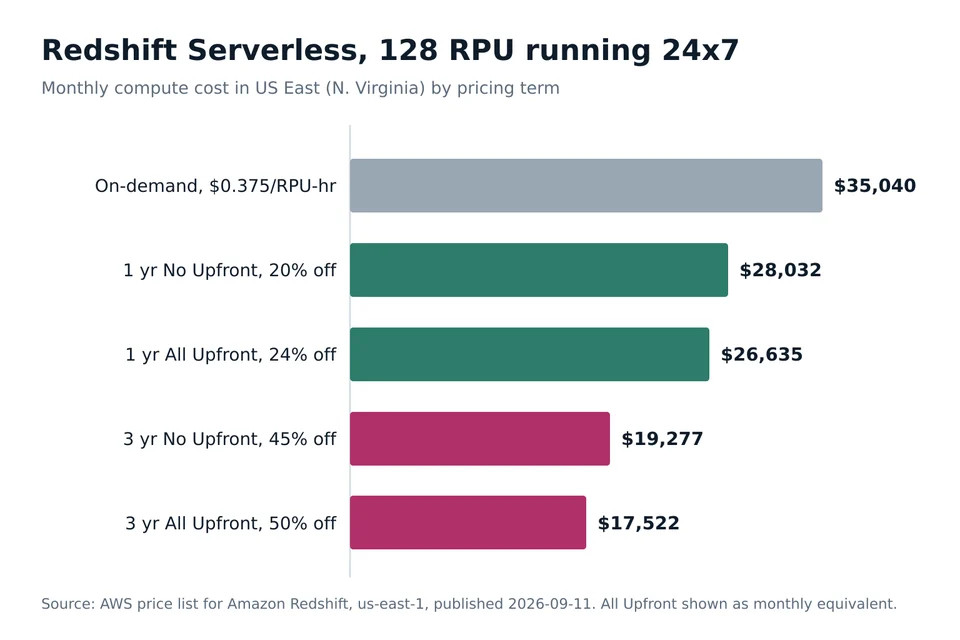
Redshift Serverless costs $0.375 per RPU-hour in US East (N. Virginia) and $0.36 in Ohio and Oregon, billed per second with a 60 second minimum and nothing while the warehouse is idle. The smallest base capacity, 4 RPUs, runs $1.50 an hour; the default of 128 RPUs runs $48 an hour. Storage is extra at $0.024 per GB-month. Serverless Reservations cut the RPU rate by 20 to 50 percent.
Every figure below comes from AWS's public price list for Amazon Redshift (the version published on 11 September 2026) and from the Redshift Serverless billing pages in the AWS docs, read in October 2026. Most guides stop at the hourly rate. The rate is the easy part. What decides the bill is how many hours a day the workgroup is actually awake, how big its base capacity is, and whether anything is keeping it awake when nobody is working. That is what this page prices out.
Redshift Serverless pricing in the US regions
| Charge | US East (N. Virginia) | US East (Ohio), US West (Oregon) |
|---|---|---|
| Compute, per RPU-hour, on-demand | $0.375 | $0.36 |
| 1-year reservation, No Upfront, per RPU-hour | $0.300 (20% off) | $0.288 |
| 1-year reservation, All Upfront, per RPU | $2,497 (24% off) | $2,400 |
| 3-year reservation, No Upfront, per RPU-hour | $0.2063 (45% off) | $0.198 |
| 3-year reservation, All Upfront, per RPU | $4,928 (50% off) | $4,731 |
| Redshift Managed Storage, per GB-month | $0.024 | $0.024 |
| Manual snapshots, per GB-month | $0.023 | $0.023 |
| Cross-region snapshot copy, per GB | $0.02 | $0.02 |
One RPU is 16 GB of memory with the compute that goes with it. Base capacity starts at 4 RPUs and goes up in steps of 8 to 512, and in steps of 32 to 1,024 in the three US regions above. N. Virginia is the most expensive of the three by about 4 percent, which is worth knowing if you are choosing a region for a new warehouse rather than following where the data already sits.
A few things are included in the RPU price on Serverless that cost extra on provisioned clusters. Spectrum queries against data in S3 are billed as RPU time, not the $5 per terabyte scanned that provisioned RA3 clusters pay. Concurrency Scaling has no separate line either: extra capacity is just more RPU-hours at the same rate. Federated queries also bill as RPU time. Zero-ETL integrations carry no integration fee, but the replication work consumes RPUs.
How much does Redshift Serverless cost per month?
Multiply the base RPUs by $0.375 to get the hourly rate, then by the hours the warehouse is busy. Five common shapes, priced on demand in N. Virginia, compute only:
| Workload | Arithmetic | Per month |
|---|---|---|
| Small team, 4 RPU base, busy 2 hours a day | $1.50 x 2 h x 30.4 days | $91 |
| Departmental BI, 8 RPU, busy 4 hours a day | $3.00 x 4 h x 30.4 days | $365 |
| Analytics team, 32 RPU, busy 10 hours a day | $12.00 x 10 h x 30.4 days | $3,650 |
| Default 128 RPU, 8 hours on 22 weekdays | $48.00 x 8 h x 22 days | $8,448 |
| Default 128 RPU, never idle | $48.00 x 730 h | $35,040 |
Two lines in that table deserve attention. The default base capacity for a new workgroup is 128 RPUs, so a team that clicks through the console setup starts at $48 an hour of active time, sixteen times what an 8 RPU workgroup would cost. And the bottom row is what happens when something keeps the warehouse busy all day. Most surprising Serverless bills trace back to one of those two problems, not the rate.
Storage sits on top and is usually small next to compute: 5 TB of managed storage is $122.88 a month. It costs the same on Serverless, RA3 and RG, so it drops out of any comparison between them.
Is Redshift Serverless cheaper than provisioned?
Serverless is cheaper when the warehouse is busy for fewer hours a day than the break-even point for the cluster you would otherwise run around the clock. AWS publishes no fixed conversion between nodes and RPUs, so the table below only shows where the dollars cross; the RPU size your queries need has to come from a test on your own workload.
| Provisioned cluster, 24x7 on demand | Per month | vs 8 RPU | vs 32 RPU | vs 128 RPU |
|---|---|---|---|---|
| 1 x rg.xlarge ($0.7602/hr) | $555 | 6.1 h a day | 1.5 h a day | 0.4 h a day |
| 1 x ra3.xlplus ($1.086/hr) | $793 | 8.7 h a day | 2.2 h a day | 0.5 h a day |
| 2 x rg.4xlarge ($3.04/hr each) | $4,442 | always cheaper | 12.2 h a day | 3.0 h a day |
| 2 x ra3.4xlarge ($3.26/hr each) | $4,760 | always cheaper | 13.0 h a day | 3.3 h a day |
Read it as: below that many active hours a day, Serverless costs less. Take the 2 x ra3.4xlarge row. The cluster costs $4,759.60 a month. A 32 RPU workgroup costs $12 an hour, so it can run 396.6 hours a month, about 13 hours a day, before it costs more. A warehouse used through the working day and quiet at night is a good Serverless candidate. One serving dashboards to three time zones and running ELT overnight usually is not.
The comparison moved in 2026 with the Graviton RG nodes: rg.4xlarge lists at $3.04 an hour against $3.26 for ra3.4xlarge, and RG clusters include data lake queries without the per-terabyte Spectrum charge. Provisioned clusters also pause, which stops compute billing, and they get one free hour of Concurrency Scaling per cluster per day. If you run RA3 today, price RG before deciding that Serverless is the cheaper path.
What keeps a Redshift Serverless workgroup billing
The pricing page says you pay nothing when the warehouse is idle. The billing docs are more careful, and the details are where the money goes:
- Keep-alive queries from BI tools and connection pools. AWS says plainly that open connection pools can generate cost with no real workload running. A health check every 5 minutes at 8 RPUs, each billed the 60 second minimum, adds up to 4.8 hours a day, about $438 a month for nothing.
- The 60 second minimum. A 2 second query on 8 RPUs is billed as a minute, $0.05. Tools that fire many tiny queries pay for a minute each time.
- System table queries. Monitoring scripts that poll SYS views are billed like any other query.
- Open transactions. A BEGIN with no COMMIT keeps consuming RPUs until the idle transaction times out after 6 hours.
- Scale-down lag. After a burst, capacity can stay above the base for a while, at the same RPU rate.
- Cancelled queries. They are billed for the time they ran.
- Short zero-ETL refresh intervals. AWS suggests 5 minutes or longer, because every refresh is RPU time.
One reporting detail makes all of this harder to catch: usage is recorded when a transaction finishes, so a long transaction lands on the bill all at once and makes daily charts jump. The guardrail AWS gives you is a usage limit in RPU-hours per day, week or month, which can log, alert or turn off user queries when hit. Set one on every workgroup on day one. It caps usage, not capacity, so set the maximum RPU value as well.
Redshift Serverless Reservations, and when they pay
Since 2025 Serverless has its own commitment, the Serverless Reservation. You commit to a number of RPUs for 1 or 3 years, billed every hour of the term whether you use them or not, and anything above the reserved level is billed on demand. Reservations are bought at the payer account, shared across linked accounts and workgroups, and cannot be changed or cancelled. No Savings Plan of any kind covers Redshift, Database Savings Plans included.
The discount only pays if the reserved RPUs are busy enough. A 1-year No Upfront reservation at $0.300 against $0.375 on demand breaks even at 80 percent utilization. The 3-year terms are more forgiving: 55 percent for No Upfront and 50 percent for All Upfront. A workgroup busy 10 hours a day is at 42 percent and should not reserve at all. Reserve only the floor that is genuinely always on, typically the RPUs consumed by overnight pipelines and around-the-clock dashboards, and leave the daytime peaks on demand.
AWS's pricing page still says "up to 45 percent" for 3 years. The price list and AWS's July 2026 announcement show 50 percent for 3 years All Upfront, which is the figure the bill will reflect. Commitment managers such as ProsperOps, Usage.ai and CloudKeeper Commit will buy and manage these for a share of savings; our comparison of Redshift cost optimization tools prices each of them, along with the free AWS options, and says which ones actually act on the warehouse.
Does Redshift Serverless have a free tier?
There is no ongoing free tier. First-time Serverless users get a $300 credit that expires after 90 days and covers compute and storage, which is enough for a proper test at 8 to 32 RPUs. The credit does not apply to reservations. Use it to measure two numbers before committing: the smallest base capacity that meets your query times, and how many hours a day the workgroup is genuinely active once keep-alive traffic is removed.
Tracking Redshift Serverless cost by workgroup and team
Cost Explorer shows Redshift as one service total. What a data platform lead needs is the split: which workgroup, which team, how much was compute versus storage versus snapshots, and whether last month's jump was a new dashboard or a stuck transaction. If finance wants the warehouse line in the monthly review, the same breakdown can go straight into a presentation for the CFO instead of a screenshot of the console.
CostAnalyst reads the AWS cost and usage export you upload and breaks Redshift spend down by usage type, so ServerlessUsage, reserved RPUs, managed storage, snapshots and cross-region copies each sit on their own line, allocated to teams by your tags next to the rest of your AWS, Azure, Google Cloud and SaaS spend. It flags a month-over-month jump as soon as the export lands, and it never needs access to your AWS account. Plans start at $59 a month on yearly billing, and you can run your own export through the demo first. If the same team also runs Aurora, our breakdown of Aurora Serverless v2 pricing does the same serverless versus provisioned math for the database side.
Frequently asked questions
How is Redshift Serverless billed?
Redshift Serverless is billed in RPU-hours for compute, metered per second with a 60 second minimum, plus storage per GB-month. You pay only while queries run, at $0.375 per RPU-hour in N. Virginia and $0.36 in Ohio and Oregon. Spectrum, Concurrency Scaling and federated queries are included in the RPU rate rather than billed separately.
What is the minimum cost of Redshift Serverless?
The minimum base capacity is 4 RPUs, which costs $1.50 for each hour of active use in N. Virginia. With no queries running the compute cost is zero and you pay only for storage at $0.024 per GB-month. A 4 RPU workgroup holds up to 32 TB, and once it scales above 4 RPUs it does not scale back down to 4.
Is Redshift Serverless more expensive than provisioned?
For a warehouse that is busy around the clock, usually yes. A 32 RPU workgroup costs the same as two ra3.4xlarge nodes at about 13 active hours a day, and more beyond that. For warehouses that are busy part of the day, Serverless is usually cheaper, because idle hours cost nothing.
How do I reduce Redshift Serverless costs?
Lower the base capacity from the 128 RPU default to the smallest size that meets your query times, set a usage limit in RPU-hours per day, stop BI tools and connection pools from sending keep-alive queries, and close idle transactions. Then reserve only the RPUs that are busy at least 80 percent of the time on a 1-year term, or 50 to 55 percent on a 3-year term.
Do Savings Plans cover Redshift Serverless?
No. Neither Compute Savings Plans nor Database Savings Plans apply to Redshift. The only commitment discounts are Serverless Reservations for RPUs, 20 to 50 percent off depending on term and payment, and reserved nodes for provisioned clusters.
See where your cloud and SaaS money is leaking
Upload your cloud billing export and see your savings in dollars. Transparent pricing, no card to start.