Nicus Alternatives for ITFM and TBM With Nicus vs ServiceNow, Apptio and MagicOrange Compared
Nicus sells IT financial management and TBM software two ways, on its own cloud or natively on ServiceNow, and it publishes no price for either. Teams shopping for a Nicus alternative are usually in one of three spots: the quote came back high, the ServiceNow dependency is a problem, or procurement wants a second bid with a number on it. We compared nine alternatives on where the cost model runs, what you are billed on, and the contract price where a public one exists.
projected this month if unattended
Spend by team
Budget forecast
The short answer
The best Nicus alternative depends on why you are leaving. To stay native on ServiceNow, the like-for-like options are Brightfin (formerly Proven Optics) and ServiceNow's own Financial Management inside Strategic Portfolio Management. To get off ServiceNow, IBM Apptio is the reference TBM model and the only large vendor with a public contract, from $80,040 a year on AWS Marketplace. Serviceware and MagicOrange suit complex chargeback, CostPerform and Yarken publish prices from $80,000 and $48,000 a year, and if the real problem is cloud and SaaS spend, CostAnalyst covers that slice from $59 a month.
Comparing the two biggest names first? Our Apptio vs ServiceNow comparison covers that decision on its own, and IT financial management software ranks the whole category with prices.
CostAnalyst is on this list, so here is the plain version first. We are not an ITFM or TBM platform and we do not replace Nicus for labor, data center, depreciation or project costing. We read AWS, Azure, Google Cloud and SaaS spend from the billing exports and subscription lists you provide, allocate it to teams and cost centers, and flag anomalies. Every vendor fact below was read from the vendor's own site, its AWS or Azure Marketplace listing, the ServiceNow Store or the TBM Council platform list. Nicus facts were re-read on nicus.com in October 2026. Where a vendor publishes no price, the table says quote only instead of repeating a third-party estimate.
How we compared
Five things that actually separate these tools
Whether you are leaving Nicus or leaving ServiceNow
These are different searches with different shortlists. Nicus describes two deployments in its own words: on Nicus Cloud the platform consumes ServiceNow data through data integration, while the ServiceNow native version accesses the data directly from the ServiceNow tables. If the native model is what you like and the vendor is what you want to change, Brightfin and ServiceNow SPM are the candidates. If the platform dependency is the issue, every standalone vendor on this page applies and the native ones drop out.
What the price is, and whether you can see it before a sales call
Nicus says on its Apptio comparison page that it offers transparent pricing and can lower total cost of ownership depending on scope and usage, but no rate appears on nicus.com, and its ServiceNow Store apps are marked Paid with no figure. Three alternatives do publish a full contract on AWS Marketplace: IBM Apptio, CostPerform and Yarken. A list price is a ceiling, not what you will pay, but it gives procurement an anchor for the Nicus negotiation even if you stay.
What you are billed on
The units differ enough to break a side-by-side comparison. IBM Apptio sells annual contracts covering up to $25M of IT spend. MagicOrange prices in basis points of technology spend under management with unlimited users. CostPerform prices by edition, with five users on Basic. Yarken prices by monthly spend managed. Native ServiceNow apps sit on top of a platform license you already pay for. Put every quote on one basis, total first-year cost for your spend and user count, before comparing.
How long until the first allocated report
Implementation is often the largest first-year cost. Nicus is candid here: it says many organizations migrating to it target 3 to 6 months, depending on scope, data quality, integrations and change management. Brightfin claims 6 to 12 weeks for itself, and Upland ComSci states ITFM and TBM success typically in 90 days or less. These are vendor claims measured on different scopes. Ask each one to reprocess a model change on your data during the evaluation.
How cloud and SaaS spend get into the model
Cloud is the line that changes daily and the one ITFM models handle worst. Nicus lists cloud cost and billing data from ServiceNow Cloud Cost Management among its inputs on the native deployment. Ask each alternative how it ingests AWS, Azure and Google Cloud billing, how often it refreshes, and who maps tags to cost centers. Many teams run a FinOps tool for the cloud and SaaS slice and load allocated totals into the ITFM model monthly.
At a glance
10 Nicus alternatives compared
← Scroll to see all columns →
| Tool | Best for | Where the cost model runs | How it differs from Nicus | Published price |
|---|---|---|---|---|
| Nicus (the baseline) | IT finance teams that want a specialist ITFM vendor on ServiceNow, or the same product as a standalone cloud | Nicus Cloud, or natively on ServiceNow | The product you are comparing against | Quote only; ServiceNow Store apps marked Paid with no price |
| Brightfin (formerly Proven Optics) | ServiceNow shops that want to stay native and add telecom and technology expense management | 100% native on ServiceNow | Same native architecture; no standalone cloud option; adds expense management | Quote only; ServiceNow Store shows Paid with no price |
| ServiceNow Financial Management (SPM) | Organizations already licensed for Strategic Portfolio Management that need project and service cost views | Native on the ServiceNow platform | The platform's own module instead of a partner app; lighter cost modeling | Quote only; no public rate |
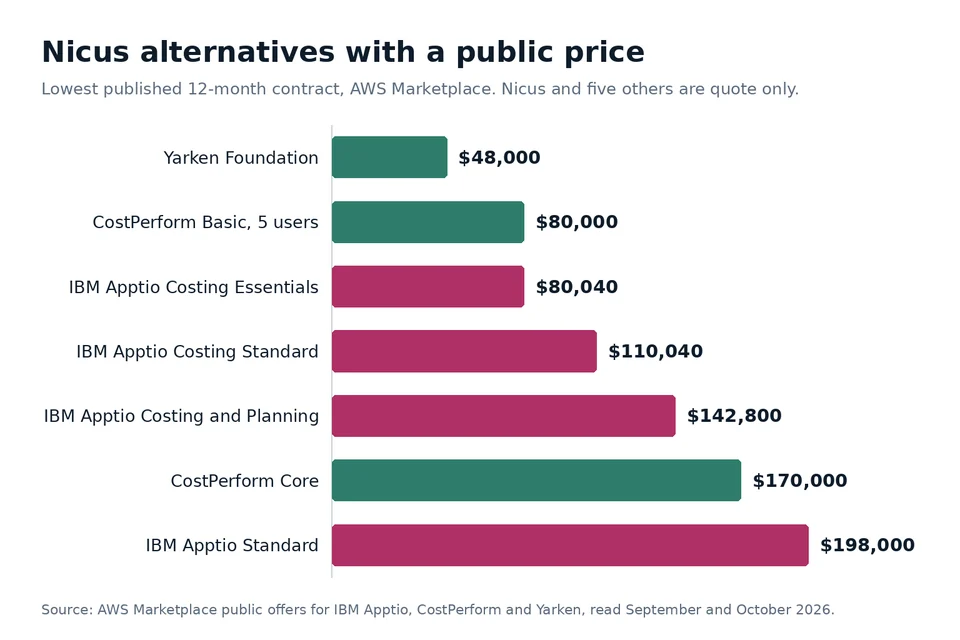
| IBM Apptio | Large enterprises that need the reference TBM cost model, planning and benchmarking outside any one platform | Standalone SaaS that syncs with ServiceNow | Standalone model with the deepest TBM taxonomy; a public contract price | AWS Marketplace, 12 months, up to $25M of IT spend: Costing Essentials $80,040, Costing Standard $110,040, Costing and Planning $142,800, Apptio Standard $198,000 |
| Serviceware Financial | Large enterprises with complex service catalogs and advanced chargeback | Standalone SaaS; connects to ServiceNow through APIs | Standalone, with stronger service catalog pricing and chargeback | Quote only; its Azure Marketplace price is labeled a dummy price |
| MagicOrange | Finance-led teams that need reciprocal cost allocation and full traceability, especially on Microsoft Dynamics | Standalone SaaS on Azure | Standalone; reciprocal costing; priced on spend under management, not seats | Quote only; priced in basis points of technology spend, unlimited users |
| Upland ComSci | Mid-to-large IT organizations that want TBM on a short implementation timeline | Standalone SaaS | Standalone; sells on speed, 90 days or less against 3 to 6 months | Quote only |
| CostPerform | Organizations that want activity-based cost modeling for IT and shared services with a public price | Standalone SaaS; sold on AWS Marketplace | Standalone; activity-based costing beyond IT; a public contract price | AWS Marketplace, 12 months: Basic $80,000 (5 users), Core $170,000 (unlimited users), Expert $220,000, Enterprise $500,000 |
| Yarken | Teams that want a TBM platform they can pilot on a monthly contract | Standalone SaaS; sold on AWS Marketplace | Standalone; the only one here with a one-month term | AWS Marketplace: Foundation $4,000 a month or $48,000 for 12 months, managing up to 2M of monthly spend |
| CostAnalyst | Teams whose IT cost problem is really cloud and SaaS spend, not the whole IT budget | SaaS, read-only billing exports | Not an ITFM platform; covers the cloud and SaaS slice only | Public, from $59 a month |
Vendors change pricing and packaging often, so confirm the current figure before you buy.
Tool by tool
What each tool is genuinely best at
Nicus (the baseline)
Best for: IT finance teams that want a specialist ITFM vendor on ServiceNow, or the same product as a standalone cloud
For reference, here is what you would be replacing. Nicus sells an ITFM Platform with IT Cost Transparency and IT Planning modules, plus FMDB apps for ServiceNow, Enterprise Architecture and Asset Management, and it has added a conversational Nicus AI Agent for guided configuration inside workflows. On the native deployment it reads CMDB configuration items, hardware and software asset data, Service Mapping, Discovery and Cloud Cost Management data straight from ServiceNow tables. It bought the consulting firm Proven FM in November 2023, so implementation comes in-house. Its site shows customer logos including Target, Ford and Optum and cites G2 rankings for support and ease of doing business. What it does not show is a price.
Brightfin (formerly Proven Optics)
Best for: ServiceNow shops that want to stay native and add telecom and technology expense management
The closest like-for-like alternative. Proven Optics, the ServiceNow-native ITFM vendor with a strategic investment from ServiceNow, acquired brightfin in January 2026 and has traded under the single Brightfin brand since 2 April 2026. The ITFM apps remain 100% native to ServiceNow, and the merger adds telecom and technology expense management that Nicus does not sell. It claims 6 to 12 weeks to implement; treat that as a sales claim and test it on your data. The trade against Nicus: there is no standalone deployment, so this only works if ServiceNow stays your system of record. Contracts that still say Proven Optics are the same product line.
Brightfin (formerly Proven Optics) compared to CostAnalystServiceNow Financial Management (SPM)
Best for: Organizations already licensed for Strategic Portfolio Management that need project and service cost views
This is the real meaning of Nicus vs ServiceNow: not two platforms, but a partner app against the platform's own module. ServiceNow's financial management ships inside Strategic Portfolio Management, with financial modeling, an allocation engine and service charging. ServiceNow staff on its own community forum have described SPM cost management as oriented to labor and configuration item costs for project work rather than ongoing asset costs, and pointed buyers to Nicus and Proven Optics for deeper ITFM. If you already own SPM and need cost views for projects and services, it is the cheapest path. If you need multi-step allocation of the whole IT budget, it is usually why teams bought Nicus in the first place.
ServiceNow Financial Management (SPM) compared to CostAnalystIBM Apptio
Best for: Large enterprises that need the reference TBM cost model, planning and benchmarking outside any one platform
The platform Nicus positions itself against, owned by IBM since 10 August 2023. Nicus puts the difference in one line, that Apptio syncs with ServiceNow while Nicus runs on it, and says some Apptio environments took multiple years to show results. Those are a competitor's claims. What is verifiable is that IBM sells Apptio on AWS Marketplace with public 12-month contracts, from $80,040 for Costing Essentials to $198,000 for Apptio Standard, each covering up to $25M of IT spend with fees above that. No other large ITFM vendor gives you a number that early. Choose it when the cost model has to stand on its own, survive audit and benchmark against peers, and budget for model reprocessing time.
See what IBM Apptio costsServiceware Financial
Best for: Large enterprises with complex service catalogs and advanced chargeback
Serviceware SE is a listed German company whose Financial product covers the IT financial lifecycle from forecasting to charging. In June 2026 it announced it was named one of three Leaders in the Forrester Wave for IT financial management software, alongside IBM Apptio and MagicOrange. Data arrives through ODBC and JDBC, CSV and XML, a REST API and a Power BI connector, so ServiceNow is a source rather than a home. Against Nicus it is the stronger pick when internal invoicing and a priced service catalog drive the project. Its Azure Marketplace listing says in writing that the listed price is a dummy, so expect a quote.
Serviceware Financial compared to CostAnalystMagicOrange
Best for: Finance-led teams that need reciprocal cost allocation and full traceability, especially on Microsoft Dynamics
A UK-headquartered ITFM specialist with US offices, built around reciprocal costing and what it calls All-Back traceability, so any allocated figure walks back to its source line. It ships connectors for Microsoft Dynamics 365, which matters if finance runs there and not on ServiceNow. Nicus itself names MagicOrange among the Apptio alternatives buyers consider. The pricing model is the clearest difference: the Azure Marketplace plan text says the subscription is based on technology spend under management, user access is unlimited, and the basis point rate falls as spend grows. The listed prices themselves are placeholders. It announced a Leader placement in the Forrester ITFM Wave in June 2026.
MagicOrange compared to CostAnalystUpland ComSci
Best for: Mid-to-large IT organizations that want TBM on a short implementation timeline
ComSci has been part of Upland Software, a Nasdaq-listed company, since November 2013, and it remains on the TBM Council list of commercial TBM platforms. Nicus names it as an Apptio alternative as well. The pitch is speed: ITFM and TBM success stated as typically 90 days or less, covering cost transparency, budgeting and showback. There is no public price and no marketplace rate card. If the reason you are leaving Nicus is a long implementation, hold ComSci to the 90-day figure in the contract, with the scope written down.
Upland ComSci compared to CostAnalystCostPerform
Best for: Organizations that want activity-based cost modeling for IT and shared services with a public price
CostPerform is the trade name of QPR CostControl, a Dutch company with a US entity, focused on linking IT cost models to business models through activity-based costing. It is one of three vendors here with a public contract: $80,000 a year for Basic with five users, $170,000 for Core with unlimited users, analysis and connectivity, $220,000 for Expert with a cloud data warehouse and test environment, and $500,000 for Enterprise. Against Nicus it fits when the cost model has to cover shared services outside IT, such as HR and facilities. The five-user cap on Basic is the line to read first.
CostPerform compared to CostAnalystYarken
Best for: Teams that want a TBM platform they can pilot on a monthly contract
The smallest vendor on the TBM Council platform list and the easiest to buy. Its AWS Marketplace listing sells Yarken Foundation at $4,000 for one month, $48,000 for 12 months, $96,000 for 24 and $144,000 for 36, managing up to 2M of monthly spend. A monthly term is rare in this category and makes a real pilot possible without an annual commitment, which neither Nicus nor Apptio offers publicly. Check how its taxonomy maps to your chart of accounts and whether the single Foundation package covers the modules you use in Nicus today.
CostAnalyst
Best for: Teams whose IT cost problem is really cloud and SaaS spend, not the whole IT budget
We cover one slice of what Nicus models and say so. CostAnalyst reads AWS, Azure and Google Cloud billing and your SaaS subscriptions from the exports and lists you provide, allocates the spend to teams and cost centers, flags anomalies daily and produces the showback report finance asks for. For a mid-size company that looked at Nicus because cloud and software bills were unexplained, that answers the question in an afternoon for $59 a month on the yearly plan. For an enterprise running a full TBM program, we are the cloud and SaaS feed into the ITFM model, whichever vendor holds it.
See how CostAnalyst worksHow to choose
Pick by the problem you actually have
You like the ServiceNow-native model and want a second bid
Get a quote from Brightfin, the only other specialist built natively on ServiceNow, and price ServiceNow SPM Financial Management if you already license SPM. Use the two quotes against the Nicus renewal.
You are moving off ServiceNow or do not want the cost model tied to it
Shortlist IBM Apptio, Serviceware and MagicOrange. All three hold the model outside ServiceNow and treat it as a data source. Apptio is the only one of the three with a public contract price.
Procurement needs a published number before any sales call
Three vendors qualify: IBM Apptio from $80,040 a year, CostPerform from $80,000 and Yarken from $48,000, all on AWS Marketplace. Everyone else on this page, Nicus included, is quote only.
The Nicus implementation timeline is the problem
Ask Upland ComSci to commit to its 90 days or less claim in writing, and ask Brightfin to do the same for 6 to 12 weeks. Compare both against the 3 to 6 months Nicus itself cites.
Chargeback and internal invoicing drive the project
Serviceware for a priced service catalog and advanced chargeback; MagicOrange if you need reciprocal allocation with every figure traceable to its source line.
The spend you cannot explain is cloud and SaaS
You may not need an ITFM platform yet. Start with a FinOps tool such as CostAnalyst for the cloud and SaaS slice, and revisit ITFM when labor, data center and project costs need the same treatment.
Questions buyers ask
Nicus alternatives, answered
What are the best Nicus alternatives for ITFM?
The best Nicus alternatives for ITFM are Brightfin (formerly Proven Optics) and ServiceNow Financial Management if you want to stay native on ServiceNow, and IBM Apptio, Serviceware Financial and MagicOrange if you want a standalone cost model. IBM Apptio is the only one of those with a public price, from $80,040 a year on AWS Marketplace for up to $25M of IT spend.
What are the best Nicus alternatives for TBM?
For a Technology Business Management program, the Nicus alternatives on the TBM Council platform list are IBM Apptio, Serviceware, MagicOrange, Upland ComSci, CostPerform and Yarken. Apptio carries the deepest TBM taxonomy and benchmarking. Yarken is the lowest published entry at $48,000 a year, and it is the only one sold on a one-month term for a pilot.
Nicus vs ServiceNow for IT financial data, which is better?
Nicus vs ServiceNow is not a choice between two platforms, because Nicus runs on ServiceNow. The choice is between ServiceNow's own Financial Management inside Strategic Portfolio Management and a specialist app on the same platform. ServiceNow's module suits project and service cost views if you already own SPM. Nicus goes deeper on multi-step allocation, IT planning and a financial database that reads ServiceNow tables directly.
Nicus vs Apptio, what is the difference?
The difference is where the cost model lives. Nicus can run natively on ServiceNow and read CMDB and asset data directly from its tables, while IBM Apptio is a standalone platform that syncs with ServiceNow. Apptio has the deeper TBM taxonomy and peer benchmarking and publishes contracts from $80,040 a year. Nicus publishes no price and says migrations from Apptio typically target 3 to 6 months.
Nicus vs MagicOrange, which should I choose?
Choose Nicus if ServiceNow is your system of record and you want the cost model inside it. Choose MagicOrange if finance leads the program, you run Microsoft Dynamics, or you need reciprocal cost allocation with every figure traceable to its source. MagicOrange prices in basis points of technology spend with unlimited users; Nicus quotes privately. Neither publishes a usable list price.
How does Nicus compare to other ITFM applications built natively on ServiceNow?
There are two other native options. Brightfin, formerly Proven Optics, is 100% native to ServiceNow and adds telecom and technology expense management, but has no standalone deployment. ServiceNow Financial Management ships inside Strategic Portfolio Management and is lighter on cost modeling. Nicus is the only one of the three that also sells the same product on its own cloud for teams that leave ServiceNow later.
Do Proven Optics and Nicus both integrate with ServiceNow?
Yes, and both go further than integration: each runs natively on the ServiceNow platform rather than syncing with it. Proven Optics now trades as Brightfin after acquiring brightfin in January 2026. Nicus additionally offers a standalone Nicus Cloud deployment, where it consumes ServiceNow data through data integration instead of reading the tables directly. Both list their apps in the ServiceNow Store as Paid, with no price shown.
How much does Nicus cost?
Nicus does not publish a price. Its website has no rate card, and its apps in the ServiceNow Store are marked Paid without a figure, so every deal is quoted against your scope and modules. For a budget anchor, the public contracts in the same category are IBM Apptio from $80,040 a year, CostPerform from $80,000 and Yarken from $48,000, all on AWS Marketplace. Budget separately for implementation.
Is Nicus built on ServiceNow?
Partly. Nicus rebuilt its ITFM platform to run natively on ServiceNow, releasing IT Cost Transparency there in 2023 and IT Planning in 2024, and it still sells the same platform on its own Nicus Cloud. On the native version the model reads ServiceNow tables directly. On Nicus Cloud it pulls the same data through integration, so ServiceNow is optional.
Is there a cheaper alternative to Nicus for cloud and SaaS costs only?
Yes. If the spend you need to allocate is AWS, Azure, Google Cloud and software subscriptions rather than the whole IT budget, a FinOps tool does the job without an ITFM implementation. CostAnalyst starts at $59 a month on the yearly plan, reads billing exports read-only, and produces team-level showback the same day. It does not model labor, data centers or projects.
Keep reading
See your savings in dollars
Upload your cloud billing export and get a prioritized savings plan. Money never moves. Create your account and get started.